


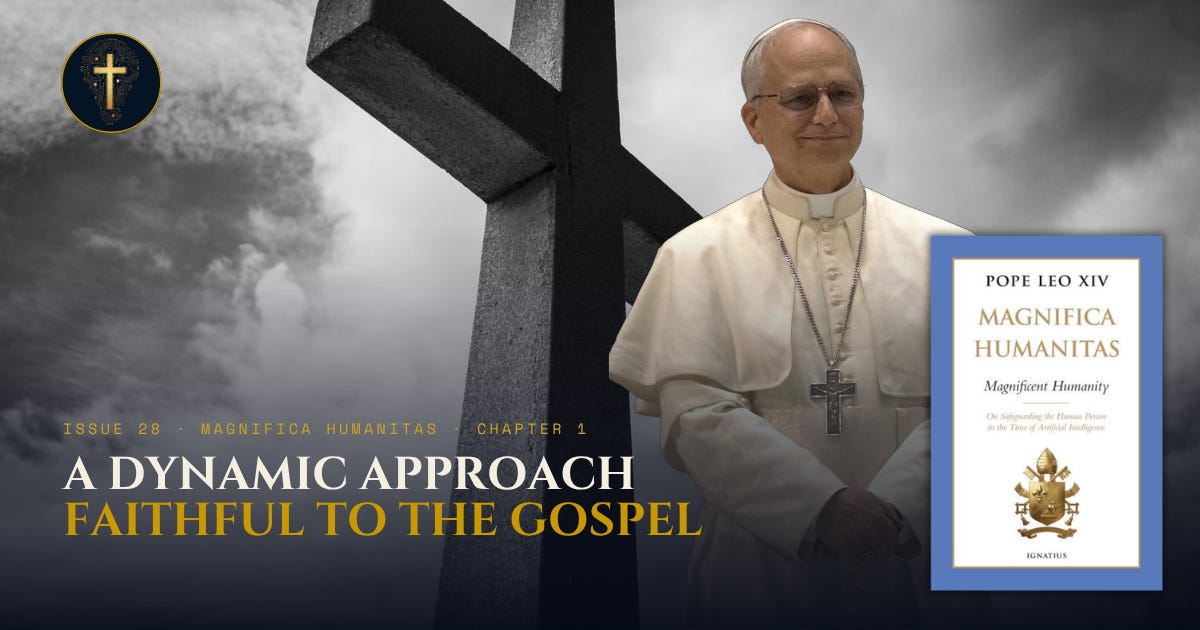
My church has a Bourbon and Books group that is reading the Pope’s Encyclical, Magnifica Humanitas: On Safeguarding the Human Person in the Time of Artificial Intelligence. What follows are my off-the-cuff notes on the various chapters and sections. It’s more for me to solidify my understanding and open up that understanding to positive criticism and correction from the brilliant thinkers who read my posts. Here we go.
Intro: Setting the Stage
The intro and the chapter I read as a single chapter. Early on, the Pope is defending his right to speak into the concrete matters of human existence. As is often the case, the Church is a political entity and has a duty to preach the moral and eternal truths of the Gospel.
When some objected that the Church should not waste energy on worldly matters, but instead focus on communicating the message of eternal life, Leo XIII responded with realism and wisdom, saying that the proclamation of the Gospel cannot overlook the concrete lives of people.
MH, ¶3.
Pope Leo presents us with two Biblical examples that Ai presents us with, both individually and collectively. Are we going to build the Tower of Babel using AI, or will we follow Nehemiah’s example of fraternal labor, each of us using this tool to fortify our humanity on a personal level and a collective one in ways that were previously out of reach?
The risk of dehumanization — of building a future that excludes God and reduces the other to a means — is an ancient and ever-new temptation that today takes on a technical guise. Instead, let us choose the “way of Nehemiah,” which highlights the importance of working together to make the City of God a safe place for returning exiles.
MH, ¶10
For those who know their Bibles, although it may be a surprise to those who think Catholics are biblically illiterate, it’s no surprise that the Pope’s solution is to exhort us to follow Nehemiah’s example, to build our own portion of the wall. Following the Nehemiah theme, it is also the case that some would use this technology for nefarious ends, augment the human body beyond natural recognition, expand government in ways that threaten liberty, especially the religious kind, or seek solutions that completely dehumanize men who find dignity in their vocation as “workers.”
This is important for Ai optimists to understand. They are in a war for the current tech, and they must fight with all their might to harness it and influence its use. There really are demons in this tech and the people who seek to wield it.
Technology should not be considered, in itself, as a force antagonistic to humanity. On the contrary, it has formed part of our history since the beginning as “a profoundly human reality, linked to the autonomy and freedom of man.” Over the centuries, technological development has significantly improved the living conditions of humanity. At the same time, each phase of progress has also revealed the ambiguity of tools that can cause harm when not oriented toward the good.
MH, ¶4
Chapter 1: The Church
The Church is present in the world as a sign of unity for the entire human family.
MH, ¶19
What follows after this quote is Pope Leo’s examination of the history of Catholic Social teaching. This makes it a bit boring, but it’s helpful to know where Pope Leo XIV is coming from. My read of this chapter is that Pope Leo is going to set the stage for the precedent of popes building on Catholic Social Teaching, which was first promulgated by Pope Leo XIII, with his encyclical RERUM NOVARUM: On Capital and Labor.
He points out that other popes had various historical events that caused them to have to apply the Gospel to their historical context. I’m pulling this list from memory, so feel free to correct me if I’m off on some of the pontificates.
Industrial Revolution — Pope Leo XIII
World War II — Pope Pius XII
Communism and Cold War — St. John Paul II
Globalization — Pope Benedict XVI
Environmental and Pandemic — Pope Francis
It’s this line of Popes and their teachings on the matter of Catholic Social Teaching that Pope Leo XIV is aiming to step into. Pope Leo XIV has taken up his pen, in the same spirit and age as his predecessor and namesake, Pope Leo XIII, to contribute to the historical moment that has been thrust upon humanity: AI.
The Catholic Church, as God’s witness and defender of humanity and its ultimate eternal end, is morally obligated to speak into matters that have the potential to render persons’ understanding of or experience with humanity unrecognizable.
The Catholic Church is the only Church that, when She speaks, every other Christian and secular institution in the world takes notice. They may reject what she says, but very few encyclicals from Catholic leaders go unnoticed by Protestant and Evangelical ones. This is good, because they are going to need the wisdom of the Church’s social teaching to ensure that they counsel their congregants and followers in the most humane way to live life in the era of AI.
Non-Catholic forms of Christianity are woefully unprepared for what is coming in the future. The three camps I see represented online are the optimists who think that Ai is a “miracle” technology, their words, not mine. Others believe that Ai is necessarily a destructive force that can only be trusted in the hands of the government. Finally, some are just asking the wrong questions, like “Should Christians use Ai?” This only highlights that they are not in the workforce, nor do they recognize that Ai is already deeply woven into society. Even typing a Google search is first going to an Ai response, not a list of websites.
The issue is not so much AI, but what AI will permit people to do. Without even touching a keyboard, users will be able to use this tech, and in many situations already are, to build and augment human experiences in ways we never thought we would have to judge. Here are a few off the top of my head:
Robots replacing service workers at restaurants and cleaning companies.
Augmenting the human body with limbs and organs that are superior to biological ones.
Cloning services to harvest organs in your old age.
Infrastructure vulnerabilities to AI hacking solutions.
Government control over who can and cannot use these technologies, creating a tiered class system where those who have the tech are economically viable, and those who are banned from it are ghettoized.
Robot warriors in the form of humanoid and non-humanoid forms. Should there be a human in the kill chain or not?
Should pastors be disciplined for using AI to write their sermons, or digitally imitate them while they are on vacation — this technology is already out there. AI avatars are a real thing.
The point that Pope Leo is trying to make is not that we should have a naive optimism or a despairing view of the future, but that Christians must engage with this tech. However, there is no mention of how much this might cost Christians should they choose to be an ethical and humane voice in the AI discussion. I suspect that when Christians begin to challenge the progress of AI, it will be met with political, economic, and physical hostility.
AI makes everything easier, including avoiding “blockers” that are often caused by virtues like integrity and the dignity of the human.
In a world where everything is easy, souls will naturally gravitate to the lowest point, hell. It’s our duty as Christians to ensure that we utilize AI to soar, not to plummet. But right now, between the AI optimists who see zero responsibility for the moral decisions of others using AI, and the Luddites who are flirting with domestic terror, we see a narrow way, and it seems few are finding it.
— DR
I have more thoughts, but I want to hear from you. Did you read the Encyclical? Any criticisms or highlights you want to share? Let me know if the comments.
Have you read the encyclical? Let me know what you think.
One thing I forgot to mention was I struggle with the vague and ambiguous language in these documents. Seems like it creates a “damned if you do, damned if you don’t” scenario. But maybe I’m wrong. What do you think?