


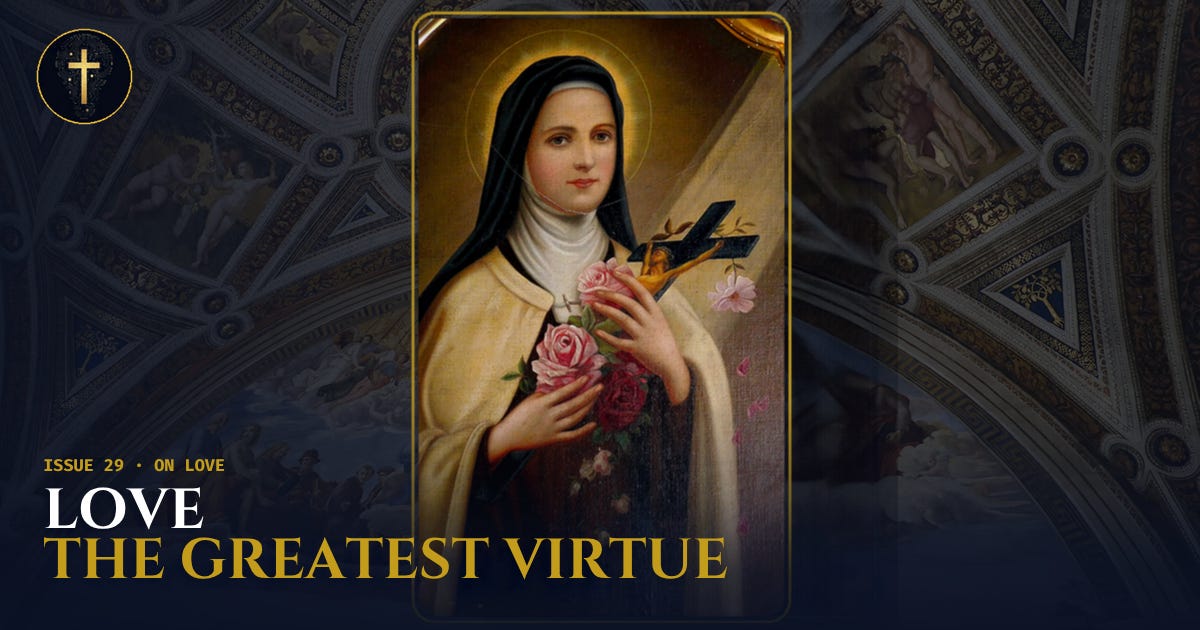
Today is the memorial of St. Thérèse of the Child Jesus (a.k.a. St. Thérèse of Lisieux). She is a saint and one of four female saints graced with the title Doctor of the Church.
I was in the adoration chapel reflecting on one of her writings on the importance of love for those who feel that they have nothing to offer the Body of Christ. I’ve posted the writing from the Liturgy of the Hours at the end of my reflection.1 Here is that reflection. May you be encouraged by it.
When one is aimless and does not know where he fits in the Body of Christ, the Church, he must not give up!
“But I am aimless,” you say. “What am I supposed to do, throw spaghetti at the wall?”
YES! But do so with love, great love. St. Thérèse of the Child Jesus became a saint for doing just this, and a Doctor of the Church!
We must, when our hearts are dry, and our souls are weak, recognize that love is the only path left. To give up is to bury love, to throw away the talents the Master has given. And when we throw away love, we also cast away mercy. When we cast off mercy, all that is left is judgment.
What wondrous love is this? It certainly does not promise bliss. Without love so wonderful, we become withered and sorrowful.
Love is a rose whose thorns pierce our minds and whose fragrance opens our hearts.
What wondrous love is this?
That makes the weak men strong and the strong men weak?
That makes cowards brave and brave men cower?
That makes the lame walk and leap, but makes the proud crippled and fallen?
This is the greatest of all virtues. This wondrous love is the Savior of the World!
Amen
— DR
Second reading
From the autobiography of Saint Theresa of the Child Jesus, virgin
In the heart of the Church I will be love
Since my longing for martyrdom was powerful and unsettling, I turned to the epistles of Saint Paul in the hope of finally finding an answer. By chance the twelfth and thirteenth chapters of the first epistle to the Corinthians caught my attention, and in the first section I read that not everyone can be an apostle, prophet or teacher, that the Church is composed of a variety of members, and that the eye cannot be the hand. Even with such an answer revealed before me, I was not satisfied and did not find peace.
I persevered in the reading and did not let my mind wander until I found this encouraging theme: Set your desires on the greater gifts. And I will show you the way which surpasses all others. For the Apostle insists that the greater gifts are nothing at all without love and that this same love is surely the best path leading directly to God. At length I had found peace of mind.
When I had looked upon the mystical body of the Church, I recognized myself in none of the members which Saint Paul described, and what is more, I desired to distinguish myself more favorably within the whole body. Love appeared to me to be the hinge for my vocation. Indeed I knew that the Church had a body composed of various members, but in this body the necessary and more noble member was not lacking; I knew that the Church had a heart and that such a heart appeared to be aflame with love. I knew that one love drove the members of the Church to action, that if this love were extinguished, the apostles would have proclaimed the Gospel no longer, the martyrs would have shed their blood no more. I saw and realized that love sets off the bounds of all vocations, that love is everything, that this same love embraces every time and every place. In one word, that love is everlasting.
Then, nearly ecstatic with the supreme joy in my soul, I proclaimed: O Jesus, my love, at last I have found my calling: my call is love. Certainly I have found my place in the Church, and you gave me that very place, my God. In the heart of the Church, my mother, I will be love, and thus I will be all things, as my desire finds its direction.
Thanks for reading! Tell me a favorite story about St Therese of Lisieux.
She discovered how God would allow her to live the martyrdom she so desired:
Let us be one with Jesus … let us make our life a continual sacrifice, a martyrdom of love to console Jesus. -St. Thérèse of Lisieux