


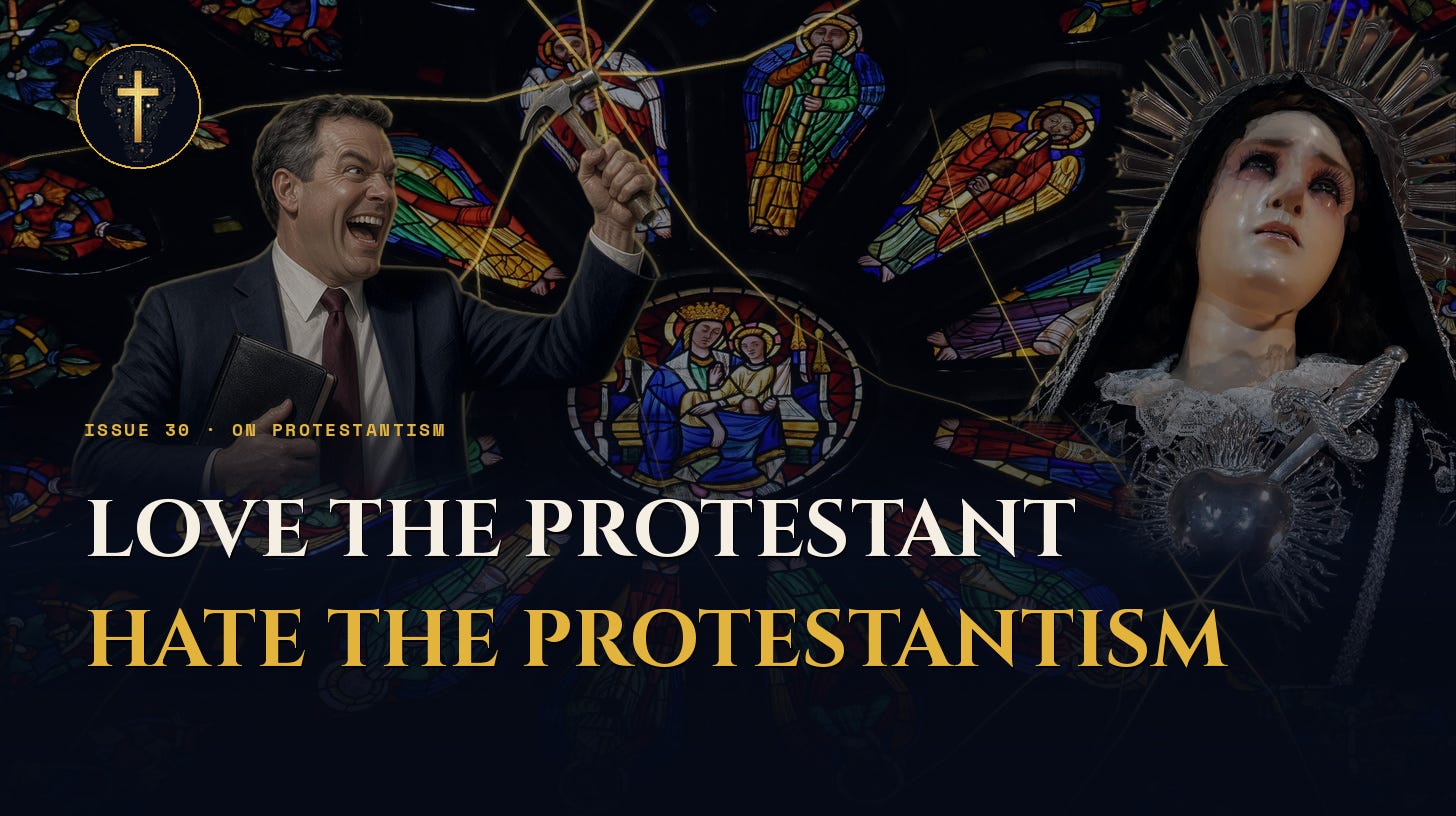
Protestant Pastor Smashes Christian Statues
If protestantism is true, then there is no difference between a pastor encouraging children to smash statues of Jesus, Mary, and the Angels, and the devout megachurch pastor who used ladders for an object lesson. This is the logical conclusion of protestantism even if these particular actions are offensive to Protestant individuals.
Below is a screenshot of a video that has gone viral of a pastor encouraging young kids to destroy statues of Angels and the Mother of God. The video is available to watch below, though I don’t recommend it as it is deeply unsettling, even if you’re not a Catholic.
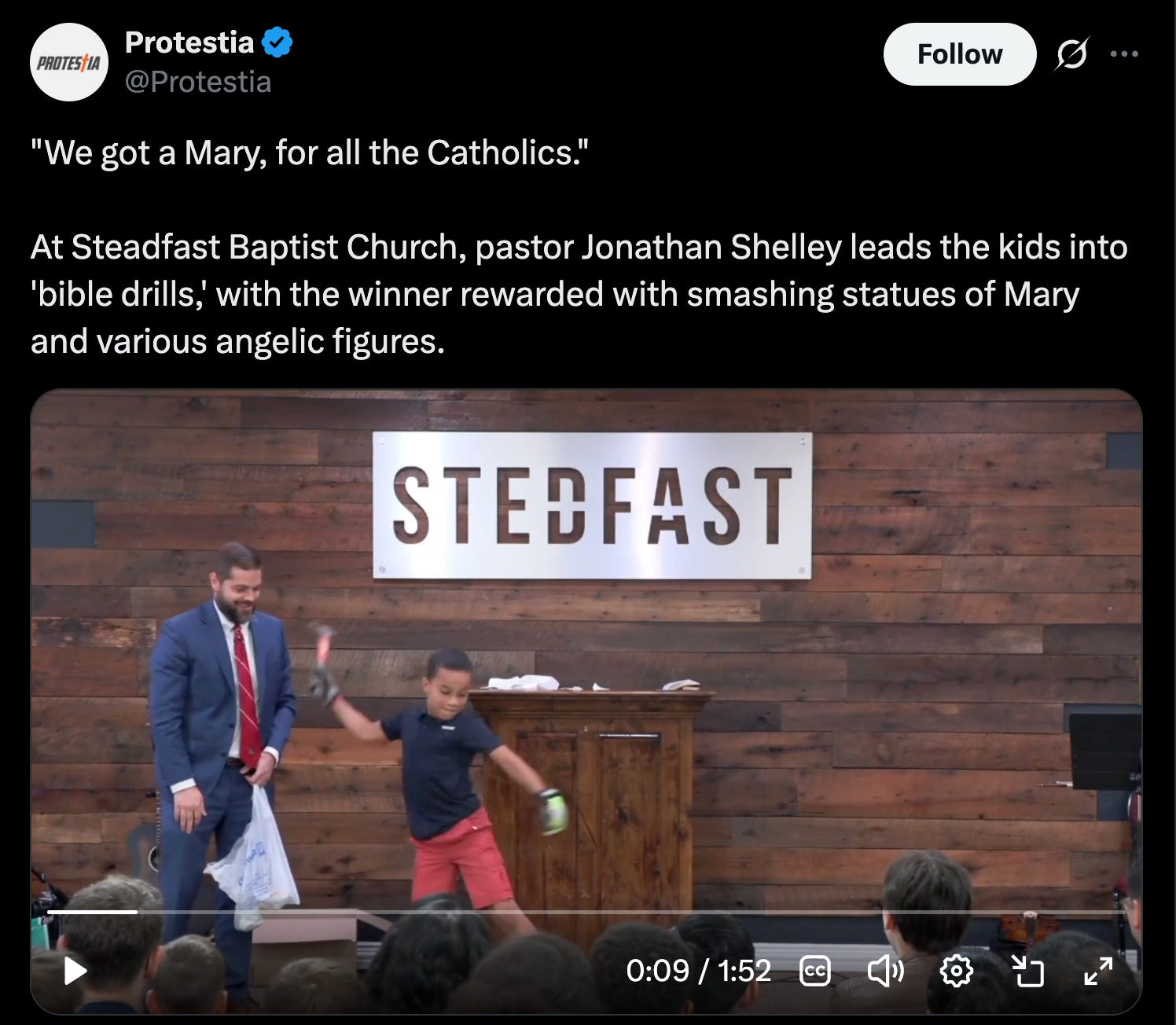
According to posts on the internet, the pastor’s name is Jonathan Shelley, and he is a pastor at Steadfast Baptist Church. Shelley is seen taking kids through an exercise known as “Bible drills” or “sword drills,” a familiar and good practice to help kids learn how to find important passages in the Bible.
The practice involves giving the kids a passage they need to look up in the Bible, and then seeing which of them can find it first. The first one to find the passage raises their Bible, and if they beat the rest of the kids, they receive a prize. In this case, it was an opportunity to commit sacrilege — the destruction of Christian statues. Be warned, even many Protestants found the video below disturbing.
Available for All Subscribers
The Catholic Church forbids the destruction of sacred statues and icons, but Reformation Protestants and the Church of England actually encouraged and required the destruction of Christian statues and art. The Church does not command this sort of behavior, but instead condemns it.
The Catechism describes the destruction of images and sacred things as “sacrilege,” and it is a damnable offense:
Sacrilege consists in profaning or treating unworthily the sacraments and other liturgical actions, as well as persons, things, or places consecrated to God. Sacrilege is a grave sin especially when committed against the Eucharist, for in this sacrament the true Body of Christ is made substantially present for us.
—Catechism of the Catholic Church (CCC), 2120
Some may wonder why destroying an image of a sacred person or thing out of vindictiveness or anger is a grave sin. As a former Protestant, I wondered the same and even told my wife to destroy a rosary that had been gifted to her by our mutual Catholic friend.
The Church condemns this action not because the statue itself is holy, although that doesn’t mean it is insignificant, but because of what the statue signifies. Your wedding ring is, in an absolute sense, just a round band of metal. But what it signifies is what makes that ring special. The ring signifies your commitment to your relationship with your wife, and your relationship with your wife gives the ring value beyond the jeweler’s monetary valuation of the ring.
The Catechism says it this way:
The Christian veneration of images is not contrary to the first commandment which proscribes idols. Indeed, “the honor rendered to an image passes to its prototype,” and “whoever venerates an image venerates the person portrayed in it.”70 The honor paid to sacred images is a “respectful veneration,” not the adoration due to God alone:
It then goes on to quote St. Thomas Aquinas’ argumentation:
Religious worship is not directed to images in themselves, considered as mere things, but under their distinctive aspect as images leading us on to God incarnate. The movement toward the image does not terminate in it as image, but tends toward that whose image it is.
So if veneration of an image or statue is not directed at the statue itself, but at the person or thing represented by it, then it follows the destruction of the statue is an offense directed at the person or thing as well. This is the same logic we apply to burning the American flag or throwing away Bibles.
In fact, in a conversation with one of my protestant friends a while back, we talked about the difficulty of having too many Bibles because once you receive one, you don’t know how to get rid of it in an honorable way when it has started to fall apart. So, we just kept them on our bookshelves, unsure of how to dispose of them because we didn’t want to disrespect God’s word.
Making Sense of Veneration for Protestants
History is incredible. When you are young, the threads of your past are disconnected and spread apart. But as we get older, they begin to come together and reveal the pattern that God used to bring us into being, and the older we get, the more our souls feel the next stitch in God’s design.
About a year or two ago, I received some WWII items from my parents that belonged to my Grandpa Roberts (may he rest in peace). He was part of the occupational force in Japan, and when he returned home from the war, he brought home a Japanese rifle and his army uniform. These were passed on to my dad, and my dad then passed them on to me.
I’ll never forget standing in the living room as my father said, “I want you to have it.” To which I responded, “Are you sure?” He hesitated. For a moment, I thought he was going to change his mind.
“Yes. He wants you to have it,” my mom yelled from the other room.
“I do want you to have it,” he said.
With that, I became the new owner of my grandfather’s WWII belongings.
Now his WWII image hangs on my wall, overlooking where I work and my desk. In some sense, I see him every morning. My grandfather and I did not have a particularly close connection when I was young, but since his death I’ve learned some things that have brought me closer to him and made me appreciate him more.
For example, I learned of a time when his business was not doing well. My dad tells the story that Grandpa called in all the kids and said, “We need to pray because if something doesn’t happen, we are going to be in big trouble.” The family knelt in their living room and began to pray. My imagination paints a beautiful picture of them all kneeling, some seated on the couches maybe, but I don’t know because I wasn’t there. But in my mind, the image is pure and holy and uncluttered from the sinfulness so often in the memory of our own experiences. I’m sure it didn’t happen exactly as I imagine, but if I was supposed to remember it exactly as it happened, I would be my dad and my dad would be me.
Another fact that brought me closer to my grandfather after his death was learning about how close he had come to death when he was young and deployed during WWII. His deployment was in the Pacific theater. The command had come down that the troops were going to go into Okinawa.
The cutoff date was announced, and my grandfather probably breathed a sigh of relief as he realized he was not going to be going. Had my grandfather been born a day later, he would have been deployed to one of the bloodiest battles in WWII, and most likely would not have made it out alive. If he had died, my father would have never existed, and by extension, neither would I.
Today, when I look at his image and rifle hanging over my desk, I know for a fact that God has a plan for my life. And while I may never have the courage my grandfather and dad had/have, looking at my grandfather’s photograph brings me a sense of purpose during those particularly monotonous and seemingly meaningless days.
But preserving something only makes sense if it has significance or value. Preserving someone else’s things, like their WWII uniform, rifle, and enlistment photograph, carries significance because I, in some sense, belong to them and they belong to me.
Now, picture this. Suppose the next time I call my mother and father, I inform them that after doing my Bible study that week, I decided to burn all my grandfather’s things because the Bible says not to have any “graven images.” They would rightly question my sanity and be gravely offended by my decision. Of course, it wouldn’t be the first time.
But the reason I wouldn’t do this is not that I really like WWII stuff. It would be because I would lose a connection to my dad, by virtue of him trusting me with something so special, but also a connection to my grandfather, who has gone on from this life to his reward.
We can see that there are analogies for respecting an image of a person or their things and the inspiration and consolation these objects can bring to a person. But let’s explore another example closer to home for both Protestants and Catholics.
A More Relevant Example
Suppose that I receive a gift from an archeologist friend. He says, “Daniel, you won’t believe what I found on my latest excursion.” As he says this, he hands me a small gift bag. Inside is a small felt box with what appears to be a jagged piece of wood that looks like it had been ripped off of something larger.
“Do you know what this is?” he says excitedly. “No, I don’t, but my guess is it’s not tree bark.”
As he chuckles at my response, he says, “It’s a piece of wood from a cross that our experts at the dig believe came from the time of Jesus’ crucifixion. One of them thought it could actually be the one that Jesus was crucified on.”
If I said, “Cooool…,” rolled my eyes, and then proceeded to throw the “tree-bark” looking object into the trash, my friend and every Christian in the world who wants to go to Heaven would rightly stop me and chastise me for being an idiot.
But suppose I didn’t throw it away.
Suppose I decided to display it in my study, where I read my Bible and pray. Occasionally, I might even open my eyes while I’m praying or meditating on a passage and look at the piece of wood, which looks like ordinary wood to the ignorant observer, but because I know what that piece of wood is and what it represents, it calls to my mind the great love God has for me and draws me closer into his heart. Is this idolatry?
No. It is merely the recognition of the significance a physical thing can have because of where it has been and where it is now. These objects are both material and spiritual because they have traversed time and space to be with us in our present.
Our touching of them is, in some sense, a touching of the untouchable, a straining for the unreachable. That is because when we touch them, we are touching the time and place in which they were brought into being. To destroy these kinds of things, whether they be ancient or more recent, would be to lock the proverbial door and throw away the key.
But the tragic thing about pastors that destroy sacred images is that, on protestantism’s view, they have done nothing immoral. But if catholicism is true, they risk their souls for all eternity.
The Battle for Souls
The only problem is that there are plenty of Protestant factions that would disagree with the destruction of Christian images and statues, including many in the evangelical space who are starting to wear Catholic medals around their neck.
Furthermore, destroying a picture or statue of Christian figures and art is an activity shared more with Muslims and Communists. The fact that history testifies to Christianity through cathedrals, altars, statues, paintings, icons, and relics is evidence enough that this “pastor” should have had second thoughts about what he was doing, unless, of course, he is historically ignorant. Not to mention, he’s in front of kids and telling them to destroy sacred images of Jesus’ Mom.
If this pastor does not repent, he’s most likely going to Hell. We ask God for mercy on his soul, but only God knows the full extent of this man’s knowledge and freedom in the act. We can and should judge actions on their eternal weight, but only God can judge a soul justly. So, we condemn the action, but we reserve judgment of his soul for God.
God does not give us certainty of another man’s soul. That’s why we must apply the teachings of the Church to his actions and make the judgment accordingly, not that we might be puffed up, but that we might be able to identify those souls who are most in danger of Hell. This provides us the basis for acting appropriately and interceding faithfully on their behalf so that they might be saved by the grace of God.
For those who might be saying, “Well, he only did this to statues of Mary and angels. What’s the big deal?” Adding to the pile of scandal, the pastor later posted a picture of Jesus pointing to his heart and said, “If someone gets me one of these blasphemous fake Jesus statues [sic], I will smash it into pieces too!” Even C. S. Lewis recognized that there was something sacred in the depictions of the Lord in crucifixes and statues.
Visible to Free/Paid Subscribers
In Lewis’s That Hideous Strength, one of the main characters is faced with the choice between worldly power and success or being ejected from society. He is a Christian, and he has been pining for a well-to-do career since you first met him at the beginning of the book. Before the elites of the world can allow him to enter into the demonic cult — which has invented an AI talking head…let the jaws drop in response to Lewis’s prescient writing — they must test him.
The Christian protagonist enters a room with a large crucifix on the floor. He’s asked to commit sacrilege so the elites of the corporation might know that the Christian’s dedication to the company’s goals is authentic. Spoiler alert: Lewis’s character would not commit the act.
The pastor in the videos above would presumably fail the test and join the demons. But if protestantism is true, then Lewis’s book loses all meaning ’and relevance, and the man in the video above need not be praised or reprimanded. Instead, we should focus on what he got right — like many Catholic apologists are fond of doing — he was teaching the kids how to use their Bibles! What a great act of service!
Obviously, Jesus would not be proud of this, but protestantism has no place for condemnation or affirmation of what this pastor did. All it can do is offer the possible ways of interpreting the situation, and leave it up to you and your conscience. That is not Christianity, because Christianity is not a relativistic religion, and any Christian who holds to a “relativistic” form of Christianity is likely to commit actions against both God’s holiness and his creation. These actions lead souls to destruction in this life and the next, which is why Christ has such harsh words for false teachers. But under protestantism, there is no such thing as a false teacher, just another pastor with another interpretation to consider.
Love Your Enemies
Bl. Fulton Sheen was the first televangelist in the United States, and he was very aware of the road American Christianity was on and the dangers that lay ahead for her future. He was adamant that Jews, Protestants, and Catholics must be united if we are to stand against the Communist revolution that was beginning to sweep through our country at his time, but has found renewed momentum during our own.
The Ben Shapiro Show recently reported that 50% of the Democratic Socialists for America (DSA) now identify openly as Communists. The pastor in the video and Protestants like him are far closer to Communists than they realize.
This is concerning because many Protestant leaders are adamantly opposed to communism as an ideology because it competes with their own, i.e., protestantism. But the one thing that both communism and protestantism require for their worldview to work is relativism. But catholicism condemns relativism explicitly and implicitly because its teachings are public and universally binding on all mankind.
But the one thing that sets catholicism apart from communism and protestantism is that, as the heavenly representative on earth of Christ’s body, Catholics are called to suffer for the individuals captured by these dangerous ideologies. Either physically, spiritually, or both.
As individuals, Protestants are nowhere near as dangerous as Communists. But if you think protestantism is not dangerous for Catholics, then I invite you to read an autobiographical work from a Jesuit priest titled The Hunted Priest. Fortunately, both Catholics and Protestants have found themselves more united in Christ today than they have been in the past.
In many respects, Protestants and Catholics can stand shoulder to shoulder against the mutual enemy, communism. Today, many Protestants and their leaders are stronger on abortion as a cohort than many Catholic groups, despite the Church’s authoritative teaching on the matter.
With that said, modern protestantism has contributed to many of our social ills, many of which appear to be beyond reversal and which have historically led to the end of nations via collapse or being conquered. I’m speaking mainly of the birthrate, which has decreased heavily as Protestants spread the idea that contraception was a “prudential” matter and that families had no moral requirement to have families. The original Christian DINK (Double Income, No Kids) were Protestants.
Catholics cannot unite with protestantism because it leads to a morally anemic and apathetic populace that now can brag about being the only Christian nation that has killed more babies in the womb than any other Christian nation in history. This is largely due to the fractured and divided nature of protestantism and its lack of unity on moral issues that makes it an influential body politically, but culturally and morally ineffective.
Protestantism today is not nearly as dangerous for Catholics as communism is. That said, many Protestant influencers like Doug Wilson have openly said that they think laws should be passed to prevent Catholics from being able to publicly express their faith (e.g., Eucharistic Processions, public Masses, etc.).
Similar things were done by Communists when they took over in European countries and the Soviet Union. As the polarization in America increases, birthrates stagnate, and capitalists continue to promote the idea that all we need is a little more money, Catholics will find themselves declared the enemy by the Anti-Christians (Communists) and the Un-Christians (Capitalists).
What are we Catholics to do in such a situation? Sheen wrote to two audiences: the audience of his time and the America in which we find ourselves today. His prescription is not easy to swallow, but I see no other option. We must be willing to suffer for those who hate us.
Writing specifically about communism, Sheen writes,
A distinction must be made between the ideology and the person, between communism and Communists…A Christian who starts with the assumption that they ought to be annihilated or sent to concentration camps — which indeed they would do to us — is not worthy of the name Christ. We are to seek not their extinction but their transfiguration. Does God hate us because we are sinners? Then shall we hate them for being a particular kind of sinner?
Protestants who destroy sacred images, blaspheme their blessed mother, and refuse to obey their Savior when he said, “eat my body” if you want eternal life, may not want us in concentration camps or Gulags, but should the Communist shadow ever be cast on the soul of our nation, they are unlikely to do much to stop it.
It might be the case that the pastor in the video above was motivated by his love of Christ, i.e., doing the wrong thing for the right reasons. If that is the case, and he ends up in a confessional later in life, his experience of God’s mercy will be as deep as the wounds of Christ.
Sheen’s wisdom continues to illuminate our understanding of the times in which we live, as well as the souls among which we walk:
Was not Paul in the early Church a greater persecutor of religion than Tito or Stalin or Hitler? There must have been thousands of Christians who in their thoughts hoped that God would send a coronary thrombosis to Paul, to take him out of this life…Would that Heaven would send someone to answer Paul! Well, God heard their prayers, and he sent Paul to answer Paul. God’s power is more manifested in the conversion than in destruction, for he knows that the bitterest enemies make the best saints…
Final Thoughts
For you Protestants out there, how confident are you in your beliefs? Would you be willing to suffer so that a Catholic would submit to what you believe is true? Unless you’re certain of the authority and accuracy of your beliefs, how could you say yes?
A Catholic may find themselves wondering the same thing. After all, doubt does not distinguish between Protestant, Catholic, Jew, Muslim, or even atheist. Doubt is often referred to as a shadow, but when it is permitted by God, it’s more akin to a blinding light.
As our eyes adjust, we see that our doubt is not a shadow but a light at our feet, leading us ever closer to the Heart of Jesus, which is wrapped in a crown of thorns. Those thorns are what we must pass through if we are to be close to His Heart.
For many Protestants, I know you think you have as much Jesus as you will ever have in this life, but put simply, you are sincere, but you are mistaken. If you’re a Protestant reading this, I pray you have the grace to push through the thorns.
For us Catholics, we are obligated by Christ and His Church to desire their salvation such that if we could suffer on their behalf, by God’s grace, we would. It is our duty to operate in grace and hope that one day any anti-Catholic Protestant or a deeply troubled Communist might one day find themselves kneeling in a confessional, experiencing the faith, hope, and love we experience in the sacraments.
It is a hard thing to accept, and I don’t claim to have “arrived” at the point of being able to accept such a cross. But that doesn’t change the fact that we must prepare our hearts and bodies for the task.
So, we ask God for the grace and faith that will enable us to suffer on behalf of others and their sins, and that God might have mercy on them and bring us all to Heaven’s finish line.
Christ, have mercy on us.
— DR
Thansk for reading! Let me know what you think of the pastors actions or the relationship between Anti-Catholic Protestantism and Communism.