


As we sat at the dinner table, my friend, a former Lutheran Priest, said, “These Marian doctrines are difficult for me to reconcile.” He and I had decided to go through the Catechism of the Catholic Church together and dialogue about its contents.
At this point, I had no issues with the Marian dogmas in Catholicism. In response to my friend, I said, “The Marian dogmas are not concerning to me because if Jesus is truly present on the altars in the Catholic Church, then even if they are wrong about something like the Marian dogmas, I would still want to be there!” For Catholics, this might be scandalous because the Church cannot err in matters of faith and morals, but for a Protestant, this is just how we think: everyone is wrong somewhere in their doctrines, so I should be where Christ is most present, not who has the most theologically accurate teaching. Obviously this is a non-sequitur because Christ is truth, but it wouldn’t be the first time people were guilty of unrealized inconsistency.
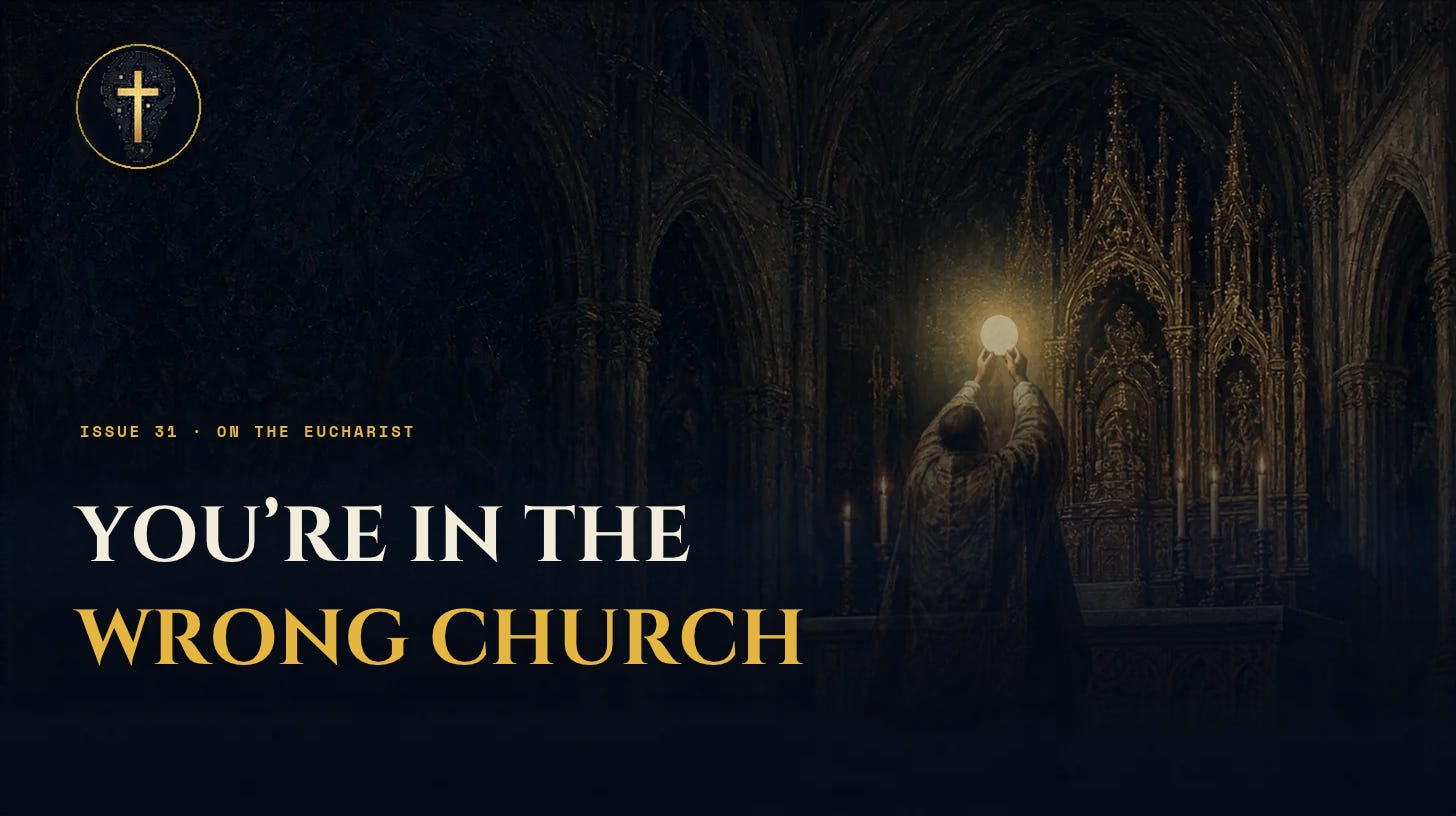
It was this Protestant logic that caused me to read the following passage from the Catechism and think, “I might be in the wrong church,”
In the most blessed sacrament of the Eucharist “the body and blood, together with the soul and divinity, of our Lord Jesus Christ and, therefore, the whole Christ is truly, really, and substantially contained.”
“This presence is called ‘real’…because it is presence in the fullest sense: that is to say, it is a substantial presence by which Christ, God and man, makes himself wholly and entirely present.
— CCC 1374
As we continued our conversations about the faith, the Eucharist was the main thing that kept coming up for me and my wife. This became a regular part of our conversations with Protestants who were engaging with us as we investigated. For the record, my wife was very resistant to the doctrine of the Eucharist. Her realization was far more profound than mine, but I’ll write about that another time.
I grew up a devout Protestant, and many of my family and friends love Jesus dearly. As Protestants, we disagreed on a lot, but one thing we could all agree on was this: If we could be in the presence of Jesus right now, then we would take it in a heartbeat.
Once someone encounters the teaching of the Eucharist in the Church, the next question is: “Is the Eucharist a primary or secondary issue for Christians?”