


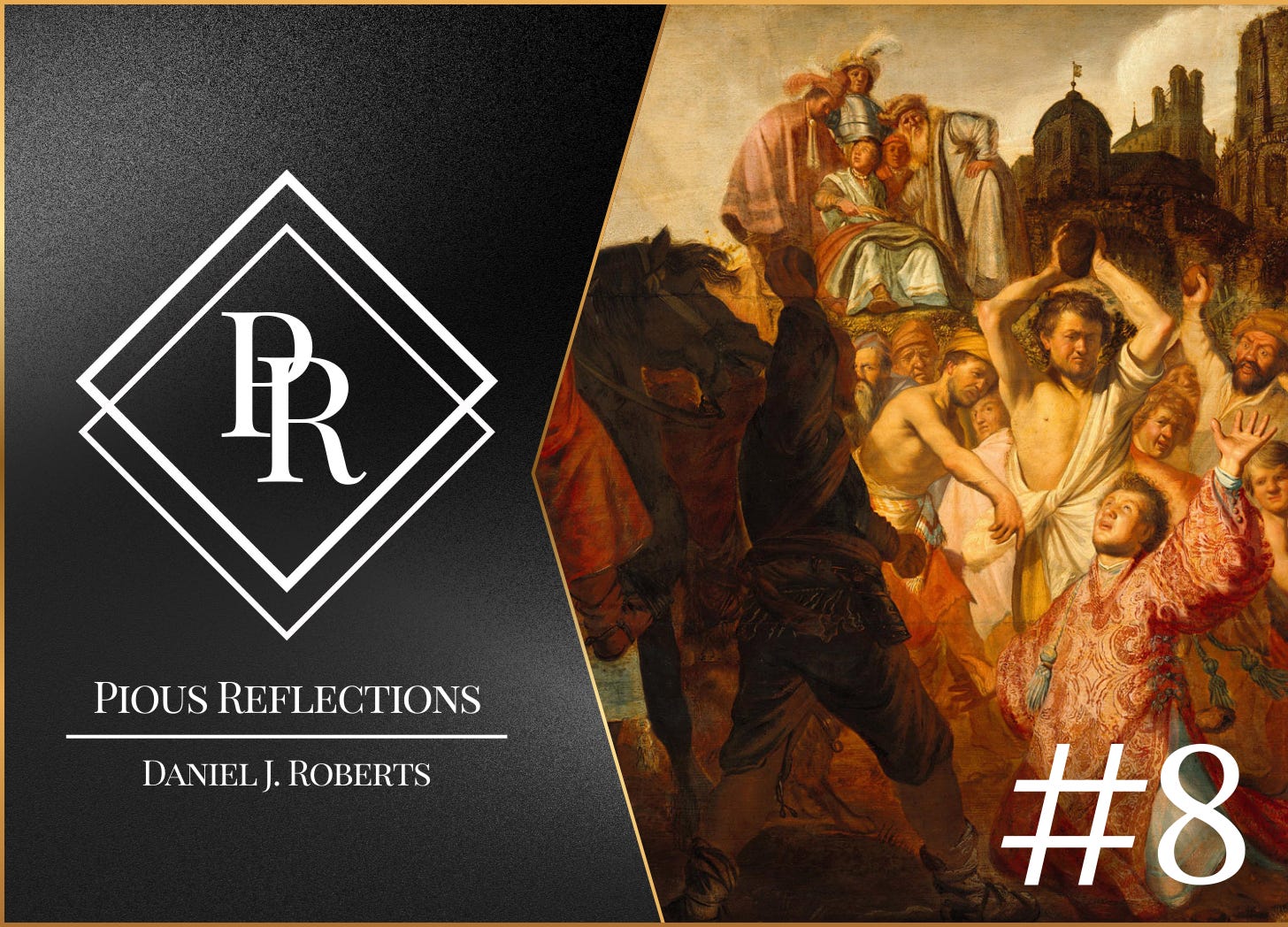
Yesterday, the world received the Christ Child. Today, Heaven receives the first Christian soldier, Stephen the Martyr.
Stephen has the title, “Protomartyr.” He is the first Christian to die for the Faith. In his death, we see that Christ calls us to become children so that we may become soldiers of Heaven. Today, the Church calls us to reflect on a sermon from St. Fulgentius of Ruspe, born in the fifth century and died in the sixth.
The sermon is titled, “The armament of love.” In it, Fulgentius opens his sermon with the line, “Yesterday we celebrated the birth in time of our eternal King. Today we celebrate the triumphant suffering of his soldier.”
The Church’s juxtaposition of Christ’s birth, the fulfillment of our expectation, is short-lived as we recognize that Christ’s teaching, as with many of his teachings, is exactly what it sounds like: “If any wish to come after me, let them deny themselves and take up their cross and follow me.” (Mt. 16:24).
St. Fulgentius directs our attention to the power of love and prayer. He writes of St. Stephen’s martyrdom,
His love of God kept him from yielding to the ferocious mob; his love for his neighbor made him pray for those who were stoning him. Love inspired him to reprove those who erred, to make them amend; love led him to pray for those who stoned him, to save them from punishment. Strengthened by the power of his love, he overcame the raging cruelty of Saul and won his persecutor on earth as his companion in heaven. In his holy and tireless love, he longed to gain by prayer those whom he could not convert by admonition.
After reading such words, one wonders about the reunion of Paul and Stephen in heaven.
Today, many Christians downplay the importance of doctrine and prayer, the two things Stephen preached to us as he died. First, he admonished those in error, showing us that to follow Christ is a costly adventure. Truth divides, but popular opinion today is to deny truth altogether, especially among Christians, even the conservative ones. Secondly, he shows us that prayer and our intercession for others are essential to their forgiveness. Don’t forget, Saul was holding the coats. We would be foolish to think that Stephen’s prayer, “Lord, do not hold this sin against them,” had no impact on Saul’s conversion.
After Christ’s resurrection and ascension, St. Stephen is the first martyr to demonstrate what it means to “deny ourselves” and to “carry our cross.” Our cross may not be made of wood; it might be something entirely different. Regardless, our prayers for those who hate us will be essential to finishing the race.
The Crown
Stephen comes from a Greek word, stephanos, which literally means “crown” or “wreath.” St. Fulgentius, in the same sermon, said, “Love was Stephen’s weapon by which he gained every battle, and so won the crown signified by his name.”
Stephen’s crown is one of stones. Which is ironic, because these stones were being hurled at him by “Sons of Abraham.” It was John the Baptist who said,
“You brood of vipers…Do not presume to say to yourselves, ‘We have Abraham as our father’; for I tell you, God is able from these stones to raise up children to Abraham” (Mt. 3:7-9).
Some might say that this is a coincidence or merely accidental to the story of Stephen’s martyrdom. These “scholars” will bring up things like, “Well, people stoned people all the time. Why would this be some significant tie-in to a statement about God being able to make Sons of Abraham from stones?”
Firstly, because God is the author of History and God knows that stoning is a preferred method of murder by the people He is trying to save. After all, He gave it to them in the Old Testament as a form of “just punishment.”
Secondly, because the passage around Stephen is incredibly typological. He is a “type of Moses” in this passage, and that is very clear when we see the Old Testament and New Testament passages side by side. Whether or not St. Luke was intentionally trying to write typologically is irrelevant. Typologies are more a function of historical events being related, not the explicit intent of the author to relate them. In other words, an author might be just “recording the facts,” and it just happens to be providentially typological.
Recall that the “Freedmen,” a group of Greek-speaking Jews, are angered by what Stephen is saying about Moses. Now read the two passages side by side.
“All those who sat in the Sanhedrin looked intently at [Stephen] and saw that his face was like the face of an angel.”
Acts 6:15
—
“As Moses came down from Mount Sinai with the two tablets of the covenant in his hands, he did not know that the skin of his face had become radiant while he spoke with the Lord .”
Exodus 34:29
Stephen’s story, by an act of the Holy Spirit, is clearly an event that is intended to remind Stephen’s hearers of Moses and the bringing of the covenant (Ex. 34:29-35). Therefore, it’s not a coincidence that Stephen, after describing much of Israel’s history and Moses’ role in it, concludes his speech with, “You stiff-necked people, uncircumcised in heart and ears, you always resist the Holy Spirit…you who received the law as delivered by angels and did not keep it.”
After hearing this, they can no longer contain their rage and begin to stone Stephen. Saul is the one standing by approving of the murder. Christ is crowned with thorns, and Stephen is “crowned” with stones. Yet, just as John the Baptist said, God actually used the stones thrown by Sons of Abraham to raise a man to Abraham.
The King
Advent is all about the anticipation of Christ’s birth. Christ enters our darkness as a child, an action foreshadowing a teaching His disciples will hear when He is an adult, “Truly I tell you, unless you change and become like children, you will never enter the kingdom of heaven.”
Beneath the imagery of Christ becoming a child and his disciples doing the same is a more foundational teaching: to enter Heaven, we must follow in the steps of Christ. Something only possible if we are willing to give up our strength, to become weak, to become a child, so that we exchange our strength, our weakness, for His strength.
The road from Heaven to Earth appears fit only for children. Christ comes as a baby to our earthly home so that we might know the way to our heavenly home. Christ does not beckon us to become children because He wants to make us weak. He calls us to become children because He did it first; we love, because He first loved us, as the Scriptures say.
But we should not believe that in becoming children we are to remain children; even Christ grew in wisdom and in stature. He does not want us to stay children. He calls us to become children, but only so that he can make us into soldiers.
We see this most clearly demonstrated in the death of St. Stephen, the First Martyr. His name was the name of the crown for champions. So, as with everything in Christianity, it is fitting. Saul, standing by, would later write these words, “In a race, everyone runs, but only one receives the prize. Run in such a way that you may obtain it.” The champion of such races would have been crowned with a stephanos, or a “crown.”
Scripture doesn’t tell us whether St. Paul was thinking of Stephen when he penned those words about winning a race to the Corinthians, but I suspect he did. One might object and say, “Prove it,” but the scriptures remind us we ought not respond to such fools, lest we be shown to be fools ourselves.
Merry Christmas
St. Stephen and St. Paul, pray for us!