


I sympathize with Protestants who look at the Catholic Church and assume that they are safer outside of the Church than they are within it, because many Catholic apologists will say one thing and do another. For example, saying that we need a magisterium because heretics are smart and persuasive and can lead souls to hell, but then posting videos promoting Protestants who explicitly say to Catholics, “Leave the Catholic Church,” is understandably confusing for the sincere Protestant trying to understand what is at stake if they choose not to become Catholic.
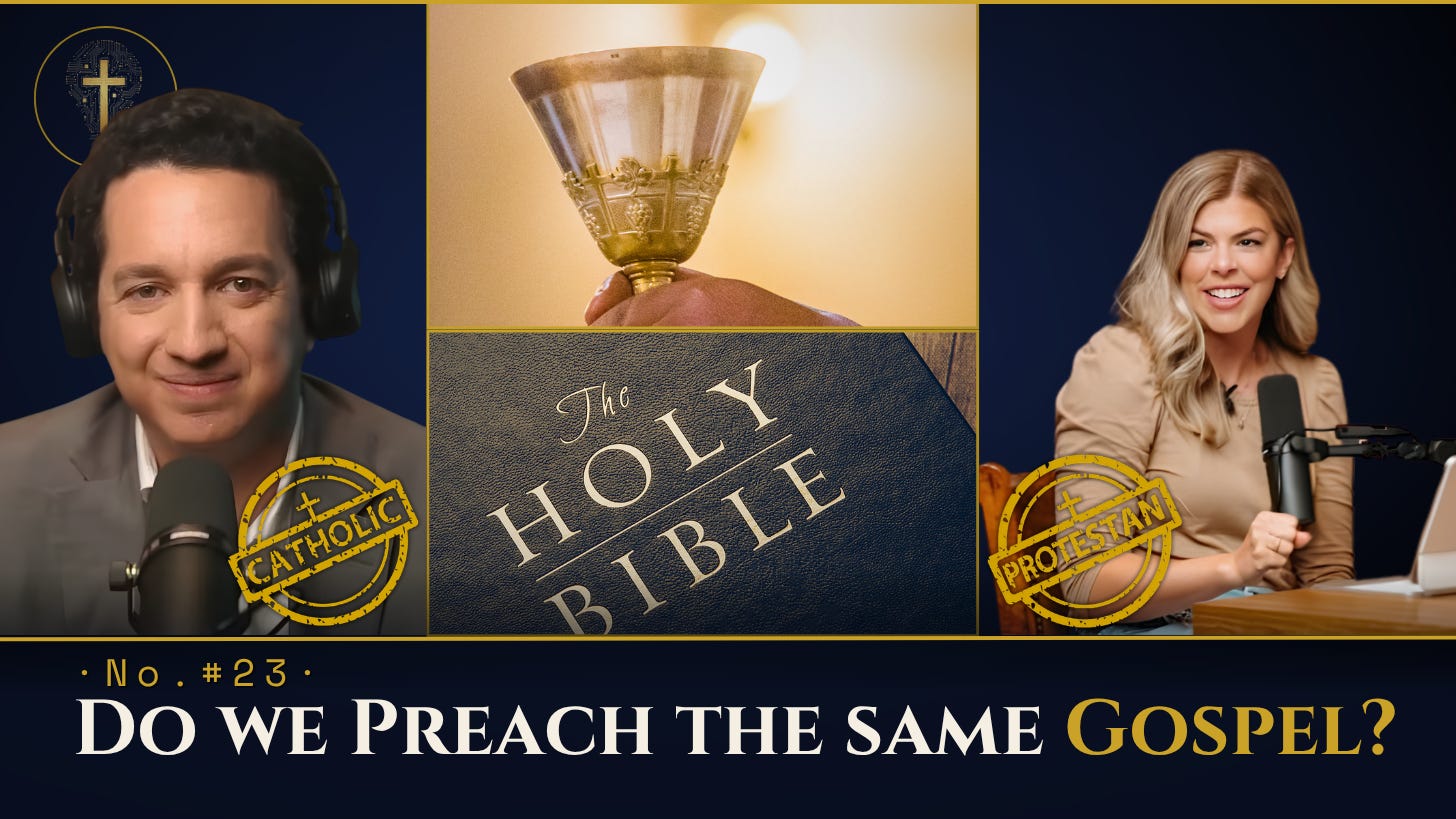
Consider Allie Beth Stuckey. She is a prominent Protestant podcaster. She has a view that the Church teaches a false gospel as well, and has had guests who come on her show, like ex-Catholic Mike Grendon, whose ministry is to get people to leave the Catholic Church and embrace the Gospel of Biblical Christianity.
In Allie’s conversation from 2025 on Catholicism with Catholic apologist Trent Horn, she borders on accusing Catholics of committing the sin of necromancy because of the Church’s teachings on the intercession of the saints. But none of this stopped Trent from endorsing her as an evangelist that Christians should “listen to and learn from.” Disclaimer: I think Trent is one of the best Catholic apologists, and I have not read a book of his I would not recommend.
To be clear, I’m not worried if Catholics and Protestants listen to Allie’s show; she is an incredible cultural warrior and ally on many moral issues shared by both Catholics and Protestants, especially on bioethics. But giving an endorsement based on the idea that we have so much in common that the substantial and “real” differences we have are not a potential risk to someone’s soul breeds confusion among both Protestants and Catholics.
It causes Catholics to think there is no reason to evangelize someone to swim the Tiber, and it leaves Protestants thinking there are no seriously dangerous heresies within their ranks. I say “seriously dangerous” because most Protestants consider the fact that they could have a heresy in their doctrine a humble feature of their institutional dogmas, not a bug.
Furthermore, if Catholicism is true, then Protestants necessarily are preaching a heretical form of Christianity to varying degrees. You can find a lot of saints who were very firm in their condemnation of heretics and the dangers they posed to the salvation of the faithful. Consider this quote from around the year 100 A.D. about the Eucharist being the body and blood of Jesus, and those who denied it being a danger to themselves and the Church.
They abstain from the Eucharist and from prayer, because they confess not the Eucharist to be the flesh of our Saviour Jesus Christ…Those, therefore, who speak against this gift of God, incur death in the midst of their disputes…It is fitting, therefore, that you should keep aloof from such persons, and not to speak of them either in private or in public, but to give heed to the prophets, and above all, to the Gospel, in which the passion [of Christ] has been revealed to us, and the resurrection has been fully proved. But avoid all divisions, as the beginning of evils.1
There are a lot of factors that keep one from seriously wrestling with Catholicism, but our rhetoric around the Gospel and salvation, in my experience, can certainly contribute to that confusion and apathy. Even Fulton Sheen said that people were leaving the faith, not because it was too hard, but because it had become too soft. Having been confused on the other side of the Tiber, I think that Sheen’s quote has continued into our time.
For example, consider the following clip of Allie Beth Stuckey from 2023 when she did a debate on The Daily Wire with Candace Owen’s husband, George Farmer.
Allie said,
Of course, I would just want to know what is the gospel and what do you think it takes to be saved? Because if someone tells me, “Well, it takes this, this, and this as a part of the Catholic Church to be saved,” well, then we’re both going to disagree. We’re both going to think the other one is not saved.
After that clip, Trent makes an argument based on the meaning of the word “gospel” and scripture.
WATCH:
Trent Horn is the one critiquing Allie’s responses. He argued that scripture never explicitly defines the gospel. He quotes 1 Corinthians 15:1-4 as the closest description. He draws a distinction between the story of Christ’s life and the teachings about how to receive the graces that come from Christ’s life. The latter is what the Church teaches is required for salvation, and that those who knowingly reject this do so at their own risk.2
I don’t disagree with Trent here, and he’s right to clarify in contrast to Allie’s view. However, Protestants, like Allie and Wes Huff (Wes is addressed in the full version of this article), would argue that faith alone is part of the Gospel. Trent appears to be reading his definition of the Gospel into the definition held and promulgated by hostile Protestants like Allie and Wes. Why? I’m not sure.
I don’t necessarily disagree with this strategy because you might be trying to show common ground, but it seems to me that Trent has taken it too far when he starts endorsing these Protestants as the exemplars of Christian evangelism when they are evangelizing that people leave the Church. After all, how many pastors do you know who would endorse an evangelist who regularly called out your pastor’s church for preaching a false gospel and told that your pastor’s congregants to find a different church to join?
If Protestants say, “We preach a different gospel than Rome, and our gospel is the true one!” We should not, as Catholics, say, “We agree on the first part about Jesus’s life, death, and resurrection, so it’s basically the same thing.” If Protestants tell you their gospel is different, believe them. If they are willing to argue that Rome is heretical on their paradigm, then we should ensure we don’t give the impression that there is no difference between what the Church teaches and what they teach.
— DR
Thanks for reading.
This is an excerpt from a much longer article on ecumenicism titled: Can We Go Too Far With Ecumenicism: A Friendly Critique of Trent Horn’s Recent Videos. You can read the full article for free by clicking the link below.
Can We Go Too Far With Ecumenism?

Disclaimer: The previous email said this was paid. It’s not paid; it’s a free post! Enjoy.
Translated by Alexander Roberts and James Donaldson. From Ante-Nicene Fathers, Vol. 1. Edited by Alexander Roberts, James Donaldson, and A. Cleveland Coxe. (Buffalo, NY: Christian Literature Publishing Co., 1885.) Revised and edited for New Advent by Kevin Knight. https://www.newadvent.org/fathers/0109.htm
Second Vatican Council, Lumen gentium, Dogmatic Constitution on the Church (Holy See, 1964), no. 14, https://www.vatican.va/archive/hist_councils/ii_vatican_council/documents/vat-ii_const_19641121_lumen-gentium_en.html.
Thanks for reading. Protestants, have you ever heard a Protestant preacher endorse a Catholic Priest or influencer as being "One of the best preachers of the Gospel?" I could be wrong. Let me know!
Catholics, do you think I'm too harsh here? What do you think? How should we answer the question "Do I need to become Catholic to go to Heaven?"
Some do, some don’t. I used to wake up to a Catholic radio program (I am an evangelical protestant but reception was difficult where we lived). I remember one priest gave a sermon Billy Graham would have approved of. The next morning another priest gave one stating that works was the only way to God. I’ve had good friends that were Catholic and definitely committed Christians who had faith. I’ve met other Catholics who “hope” that their good works will outweigh their bad, don’t read or believe the Bible, and might as well be atheists as far as their lifestyles go. I am sure the same could be said for many protestants, but the question doesn’t have a firm answer.