


Daily Wire host Andrew Klavan posted a video this past week responding to his colleague and friend, Matt Fradd. Before joining the Daily Wire, Matt Fradd created a lot of content responding to Mormonism, and it was only natural that he would continue this after joining the DW.
On May 1st, Fradd posted an article, “7 Reasons Joseph Smith Was A False Prophet.” This angered some of the Mormon subscribers at Daily Wire, and so Klavan took it upon himself to respond to Fradd’s zealous evangelistic tendencies.
Klavan “Started the Fire” 🎵🎶
In the video, Klavan argued that Matt should not be criticizing Mormonism. Which, if you know anything about Mormonism or Christianity, is a shocking thing to hear from a self-professing Christian. But this is because for most hosts at the Daily Wire, their faith is the backdrop for their political commentary, which most Mormons and Christians would support. But for Fradd, his content has always been Catholic first, culture second. Which means there is a conflict of interest in terms of what is “good for business” for the Daily Wire.
This is a fair question to ask: Is it true that Daily Wire will permit Fradd to keep his brand if his desire to “Win souls for Jesus” conflicts with their business model?
After expressing how much he loves Matt Fradd as a friend, Klavan proceeds to critique Fradd’s decision to publish the article. Here’s a bit of what Klavan said,
I have to say I don’t agree that [Matt] should be doing this. I’m not saying, ‘Oh, it’s a terrible thing.’ I’m just saying, you know, people love their religion. It sustains them. We all know we have disagreements between our creeds…but if Mormons aren’t blowing people up, you know, leave them alone. You know, that’s why I pick on religions when the religion is producing something bad.
Whatever Klavan’s intent, the optics definitely give the vibe, “Hey, do you know where you work? You can’t do that kind of stuff! You’re angering our customers!” You can watch his full video below.
But this article is not intended to be a “gossip” piece about the Daily Wire drama. Rather, Klavan presents a form of Christianity that is intellectually prideful Christianity masquerading as intellectually humble Christianity. Which is worthy of a response, even though he’s not blowing anyone up.
Klavan represents a growing belief within Christianity that everyone’s belief systems are equally valid because all of them have nice people in them. More and more people are saying things like, “Well, in the end it doesn’t really matter as long as you love Jesus,” or “We all have something doctrinally wrong in our Christian expression.” Klavan is a good guy, and I’m sure he and I would have a great time chatting if I ever get the opportunity. But in the end, if Matt, according to Klavan, cannot criticize the Mormon religion, and Klavan can criticize the Catholic religion, then one ought to criticize whatever kind of Christianity it is that Klavan represents.
Artists & Truth
Klavan is an artist first, podcaster second. For most of us, we are fathers, mothers, sons, daughters, friends, and workers first, and “theologians” second. That is, we have a lot of competing responsibilities in our lives that keep us from going as deep or speaking as clearly on controversial topics as we would like.
This is an important detail because artists tend to be better truth tellers in their preferred medium than they are when they are asked or choose to speak on a particular topic or issue. The artist’s gift is enhancing the brilliance of truth by uniting it to the passions.
An artist loves fiercely, which is great when he loves the truth, but when it’s divorced from truth, it leads to greater errors. That is what appears to have happened here with Klavan. He loves Jesus, loves his family, but the artist in him recoils whenever someone reminds him that, without truth, one’s theology is either a good lie or a beautiful one.
With that qualifier out of the way, Klavan made several claims in the video, but there were three major ones that he made in quick succession that I would like to address.
#1 Peaceful Religions Don’t Need Jesus
First, the idea that a peaceful religion is a religion that doesn’t need the truth. In the video, Klavan says, “If Mormons aren’t blowing people up…leave them alone.”
This implies that a group can be called “Christian” just by virtue of claiming the name, Christian. This is a nominalist view of Christianity that asserts that as long as your religious name includes the word “Christian,” then the rest of the world should acknowledge you as a valid expression of Christianity. Furthermore, this logic is the same logic defended by the transgender movement.
Both groups, the people who say you must acknowledge their Christian identity regardless of their doctrinal assertions and those who claim that you must acknowledge they’re a gender identity regardless of their biological facts, are depending on your desire to avoid conflict so that their ideology or religion can be normalized.
Boys and girls are born with a certain nature and identity. Similarly, one is born again by a certain baptism, which is Trinitarian — “I baptize you in the name of the Father, the Son, and the Holy Spirit. Amen.” Not all groups that claim the name “Christian” will agree with that statement, Mormons being one of them, since they deny the Trinity.
But Klavan’s argument is essentially: “If non-Christian groups are nice, just leave ‘em alone.” But obviously, this is not the criteria for evangelism that spread the faith around the world. Furthermore, how many atheists are happy and good citizens? Assuming they’re happy and having kids, should we just let them wallow in their materialistic bliss and hope that Jesus appears to them? Christians who hold to this idea are viewing Christianity as a political tool, not a source of salvation for all mankind.
The reason Matt Fradd and other Christians evangelize Mormons is that they believe Mormons are leading souls away from the Church and into apostasy. Any soul that is ignorant of or rejects essential Christian teaching is ultimately a soul risking their salvation.
For example, Klavan has argued that St. Paul is too conservative about sexual sins and the Church needs to change her teaching on homosexuality — perhaps Klavan has changed his position on these statements, but as he said in the video, he’s pretty set in his ways.
The reality is that St. Paul, the apostle who wrote most of the New Testament and whom Andrew Klavan takes serious disagreement with, talked extensively about false teachers and the need to destroy their claims and arguments.
For the weapons of our battle are not of flesh but are enormously powerful, capable of destroying fortresses. We destroy arguments 5 and every pretension raising itself against the knowledge of God, and take every thought captive in obedience to Christ, 6 and we are ready to punish every disobedience, once your obedience is complete.
2 Cor. 10:4-6
Matt Fradd was destroying the Mormon arguments because it is a religion that “raises itself against the knowledge of God.” The fact that Klavan decided that he was going to attack Matt Fradd for trying to lead people away from the errors of Mormonism. Perhaps there were Christians in the early Church who shared Klavan’s perspective, which might be why St. Paul wrote, “…we are ready to punish every disobedience…” One can imagine Klavan responding with, “Who does this guy think he is, telling me what to obey and what not to?” As individuals, we all have issues that need to be corrected, but if no one corrects us, we will remain in ignorance.
#2 No One Agrees, So No One Needs to Evangelize Their Creed
Have you ever heard someone say, “Well, no one has it all right,” or “I think that God is working in all the denominations, so I focus on the strengths of each denomination rather than the weaknesses”?
Klavan takes this angle too, and I have heard this objection more frequently since becoming Catholic. I intend to do a deeper dive on the errors in this kind of thinking, regardless of whether you’re Catholic or Protestant, but for now, the response will be brief and specific to Klavan’s video.
Statements like the ones above are not compatible with Christian teaching. Christians who hold to this view are unintentionally emphasizing an agnostic belief over the Christian teaching that we can know the truth.
Klavan does this when he says, “We all know we have disagreements between our creeds…” This is a subtle critique of Matt Fradd and any Christian for the last 2000 years, Protestant or Catholic, who believed so profoundly in their Church’s teachings that they evangelized others to the point of death.
One might object because Klavan doesn’t explicitly mention Protestant-Catholic disagreements in this quote. But later on, Klavan, again breaking his own rule about the people blowing up people being the ones we should criticize, attacks Catholics on their theology of Mary’s Virginity.
We all have areas of doubt. And I think that when people challenge a proposition [sic] I talk about the perpetual virginity of Mary all the time. Catholics and Protestants, you will go crazy when you challenge it. And I think, why? You weren’t there?
This shows that much of Klavan’s critique is rooted in his frustration with Catholics generally. He really struggles with the teachings of the Church and its exclusivist claims. Klavan would rather a Catholic who says, “Yeah, I’m just Catholic for the smells and bells. I don’t really care about what people believe,” rather than a Catholic who is so convinced that the Church’s teaching is true and superior to any other Christian expression.
But before he launches into this critique of “crazy” Catholics and Protestants disagreeing over the virginity of Mary, Klavan has a very insulting take on anyone who would dare to get “prickly” about their beliefs,
“This is not about Mormons. You know, this happens to everybody. I think people get very, very prickly about religion. And personally, I think it’s because they are unsteady in their belief.”
According to Klavan, if you’re secure in your faith, you will keep your faith and criticisms of others to yourself.
Based on Klavan’s perspective, we would have to assume that St. Paul was evangelizing the world, suffering on behalf of Christ, and preaching about sexual immorality to the entire Roman Empire because he was not “secure” in his faith? This reminds me of the claim that those who criticize homosexuality are homophobic. It’s an attack on someone’s psychology rather than dealing with the argument that they are making against a particular belief and lifestyle.
Klavan decided that he was going to go after his friend for writing an apologetics article arguing against Mormonism. Then, after getting flak for his post, he doubled down and implied that Fradd and the Christians who evangelize and defend their doctrines passionately are insecure in their own beliefs.
It couldn’t be that these people actually believe Christianity is the answer to all errors and evils in the world.
Klavan’s perspective is “None of us were there, so no one really knows what is or is not Christianity. Which is why you should listen to me because I’m the one who figured it out.” This position leads one to believe that Klavan lives as if Christianity and its teachings are a “choose your own adventure,” and there is a Christian morality for everyone!
The person who says, “No one has figured out what is or is the fullness of Christianity,” is revealing something about their own hubris, not something true about reality or the nature of religions in general. They might say this calmly, even intending peace and unity, but they are subtly setting themselves up as the judge of all individuals and institutions based on their own ignorance.
This is especially offensive to Catholics since the tacit ask is, “You agree, right? That Catholicism has errors in its doctrines, just like my church does?” To which the Catholic is obligated to say, “No”.
One might say, “But, if there were a Christian church that got all the doctrines right, that would be a miracle!” Yes, it would.
#3 Klavan’s Inconsistency
Finally, Klavan makes the statement, “You know, that’s why I pick on religions when the religion is producing something bad.” But what gives Klavan the right to say that the heresies of Mormonism are not “bad” enough to warrant a response? Maybe Matt Fradd knows something about what Mormons teach that Klavan doesn’t?
This is why Christian listeners get frustrated with Klavan. It’s not because he’s “started a fire storm,” it’s because he is a liberal Christian who claims to be a conservative one. For whatever reason, Klavan does not see how his views of the world are the seeds of relativism and the woke mind virus that convinced the world that men could become women. The advocates of this movement even made similar arguments about homosexuality and transgenderism that Klavan is making about which religions should or should not be critiqued: “Well, they’re not hurting anyone, so just leave them alone.”
Advocates of LGBT+ ideologies could say this because society had not embraced homosexuality and transgenderism as normative. But now that the lifestyle is embraced openly by society, we are seeing atrocities that are unique to this group.
Babies born to gay partners born from surrogacy are crying for their “mamma,” while the gay man says, “There’s no mamma now.” Or even worse, two gay men are now charged with the murder of a baby boy they adopted.
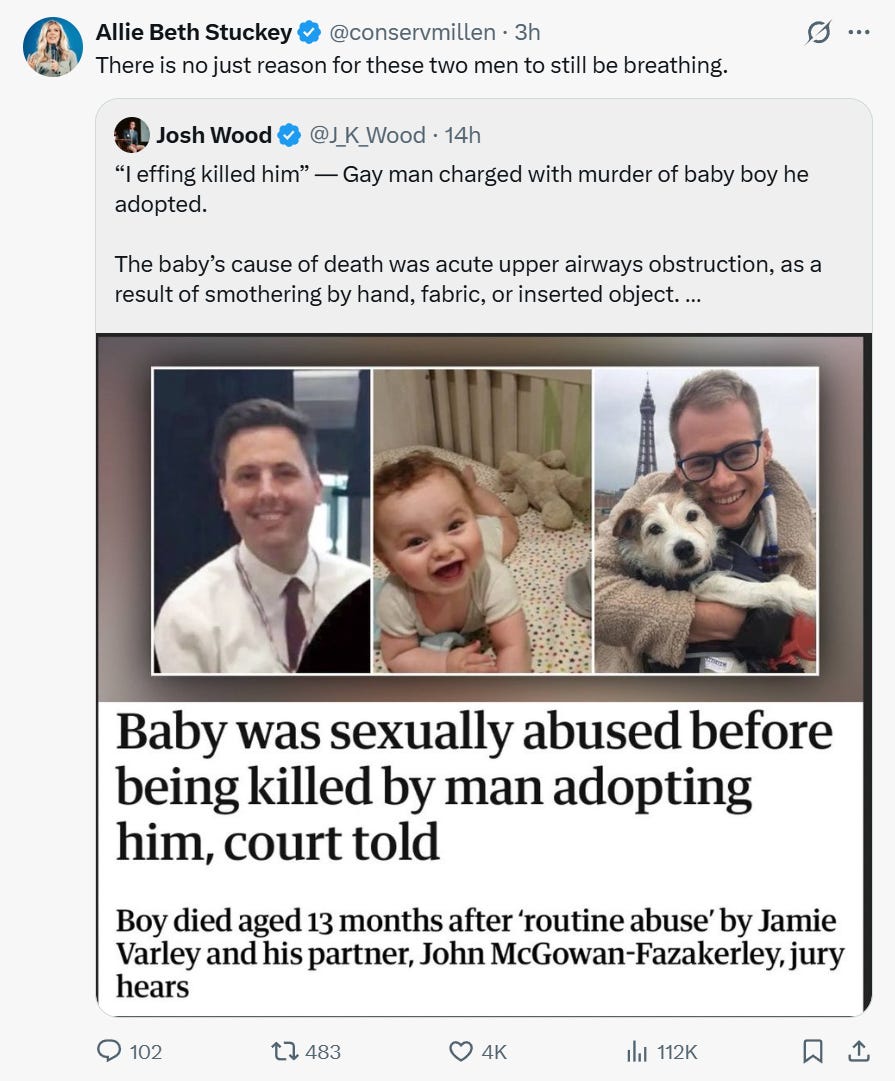
Does this justify us in critiquing homosexuality and its morality as harmful to society, while simultaneously acknowledging that Klavan’s son is a brilliant and exceptional thinker about Christianity? Klavan would most likely say, “Yeah, we should condemn these individuals, but that doesn’t mean that all gay men are murdering babies.” Which is true! We would say, “Christians do evil things, but this doesn’t mean that Christianity is evil.” This is why Klavan’s principle doesn’t work. We should be attacking the claims of a religious group, because the evils that individuals commit do not necessarily implicate their entire worldview: “all have sinned and fallen short of the glory of God.”
With stories like the one above, does this permit Christians to evangelize those living a homosexual lifestyle, per se, or will this be bad for business, too?
Not all homosexuals are committing heinous crimes like this one. But the headline highlights the inconsistency in Klavan’s argument. There are many within the gay community taking stands against Transgenderism, which is a win for political and Christian conservatism, but that doesn’t make the gay community off limits for evangelism and criticism any more than it does Christianity or Mormonism. To view this way would be to see groups primarily as political pawns that you are trying to manipulate towards your own strategy to win the culture war.
Christians should not see people as “political pawns” for their culture war. Christians can ally with like-minded people on politics even if they are spiritually and morally far from God, and I think Klavan would agree. But the moment one of us decides to evangelize those in the conservative coalition, Klavan will be the first to push back on our efforts to help them find eternal life. Additionally, Mormons who took this as an “attack” are openly attacking Catholicism and Protestantism all the time. They should be willing to take the criticism as an opportunity to respond. For example, if Klavan responded to this article and said I was wrong, I would be thrilled! It would allow me to engage with a person and company I respect, but also think gets some things wrong.
Christians take issue with Klavan, not because he’s a fire-starter or that he has profound takes on Christianity that they can’t handle, but because he has double standards. His positions on evangelism and homosexuality are insulting to the sacrifices Christians made for the last 2,000 years. It’s precisely because people chose not to remain silent about their faith that someone like Klavan is even aware of the faith, let alone converted by it.
There are many Christians who will say that our differences don’t matter. That by and large, everyone is doing the best they can, so we don’t really need to worry about which church we go to. But if this was the way any Christians lived throughout history, then Christianity would have fizzled out a long time ago.
Regardless of one’s religious traditions, all religions make exclusivist claims because all religions make truth claims. This includes Protestant denominations as well. There is no such thing as the “Protestant teaching on Baptism” or the “Protestant teaching on salvation.” Each Protestant community has exclusivist claims that are risks to one’s salvation if they reject them. For a good example of this, see Trent Horn’s video in the footnotes below.1
Conclusion
The rub for Klavan appears to be that he hates the idea that he’s as much of a fundamentalist as the Christians who view Christianity as knowable and objectively true. This is because the objectivity of truth is behind every truth claim.
Later on, Klavan argues that Catholics are crazy for getting worked up over Protestants attacking the belief that Mary was a virgin. According to Klavan, Catholics are supposed to just keep quiet about their beliefs and let the relativists and modernists determine what is or is not an essential issue of the faith because Catholics are just legalistic Romans who are “LARPing” their faith — Live Action Role Playing.
In the end, Klavan’s view is what many Protestants have today, either implicitly or explicitly: an agnostic view of Christianity. We can’t really know what Christianity teaches because no one is smart enough to “figure it out,” which is true. That’s why the Lord sent the Holy Spirit to guide the Church.
For Christian’s like Klavan, revelation and doctrine are ultimately up to the individual. Which is to say that Christianity and its teachings are really more like the Pirate’s Code; they are really more “…what you would call, ‘guidelines.’”
— DR
I’m Daniel Roberts, a Catholic convert from Protestantism with a Master’s in Philosophy in Religion from an evangelical seminary. My writing explores the intersection of faith, culture, and technology.
Trent Horn Answers the Objections Made by “Once Saved Always Saved” Theology:
Thanks for reading!
What do you think of Klavan’s video?
Do you think my response is too harsh?
Do you think Fradd’s content is going to hurt or help the Daily Wire?