


Ryan Burge is an account I follow on Substack and X. I recommend you do the same.
He does a really good job capturing the current social data around Christianity. He’s a great follow regardless of your denomination, but be prepared to be discouraged — this too is irrespective of your denomination.
He frequently goes viral for his infographics about trends in Christianity. Below is one about the trend of non-denominational church attendance being on the rise.
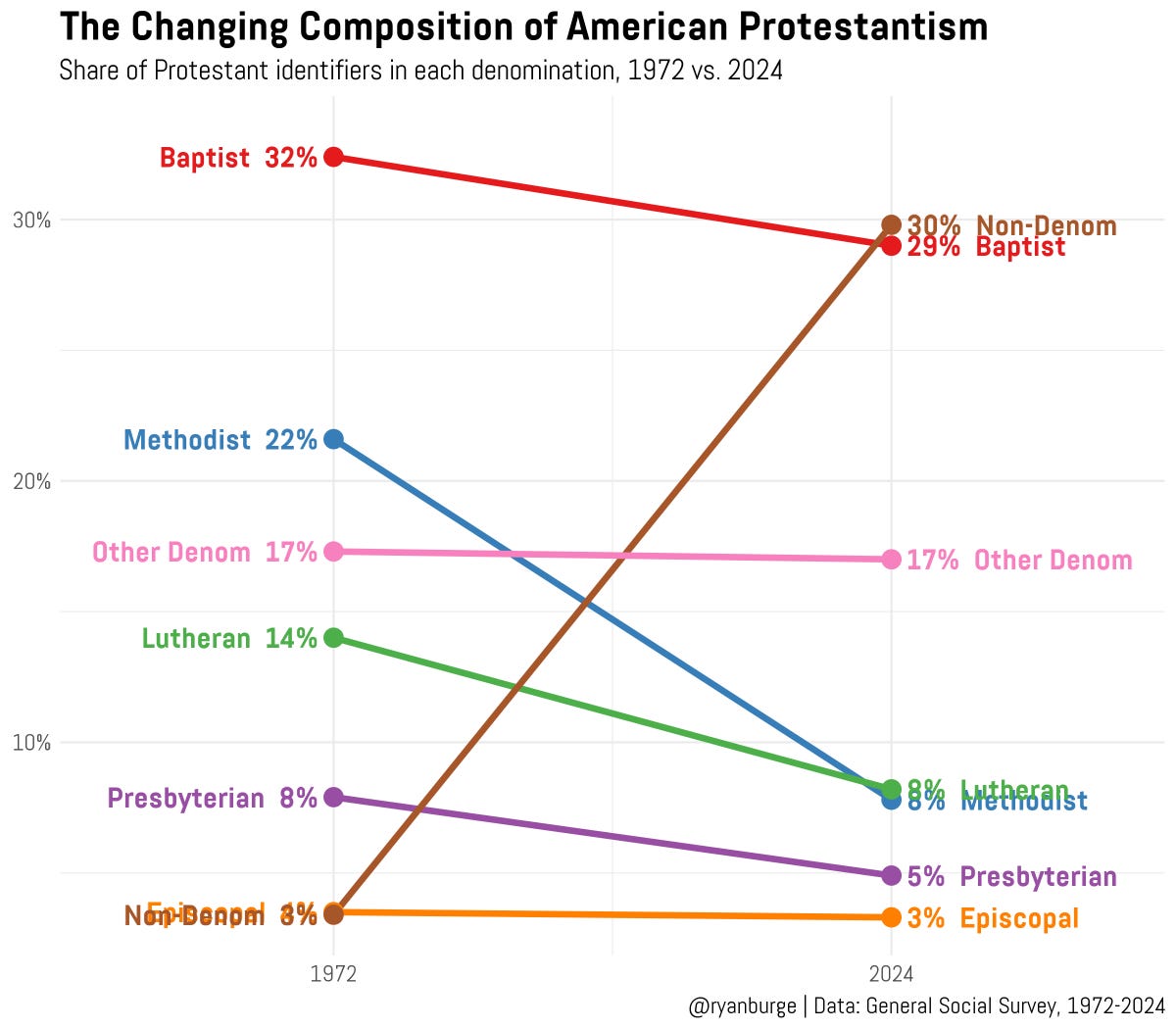
People are noticing the obvious jump in non-denominational church attendance. This is not good.
There is nothing that unites Non-Denominational (ND) churches doctrinally, which means we have no idea what these Christians actually believe. Take any two churches from the “non-denominational” category, and you will find wildly different doctrinal commitments. Here’s an example of two independent churches in California. I asked AI to find non-denominational churches that had doctrinal statements and thought it was important, and those that did not. Then I asked it to create a summary of the two churches.
The one on the right is Grace Community Church, founded by the late John MacArthur. They are very serious about their doctrinal commitments. The other is Mosaic (left), which is based in LA and has multiple campuses around the world.
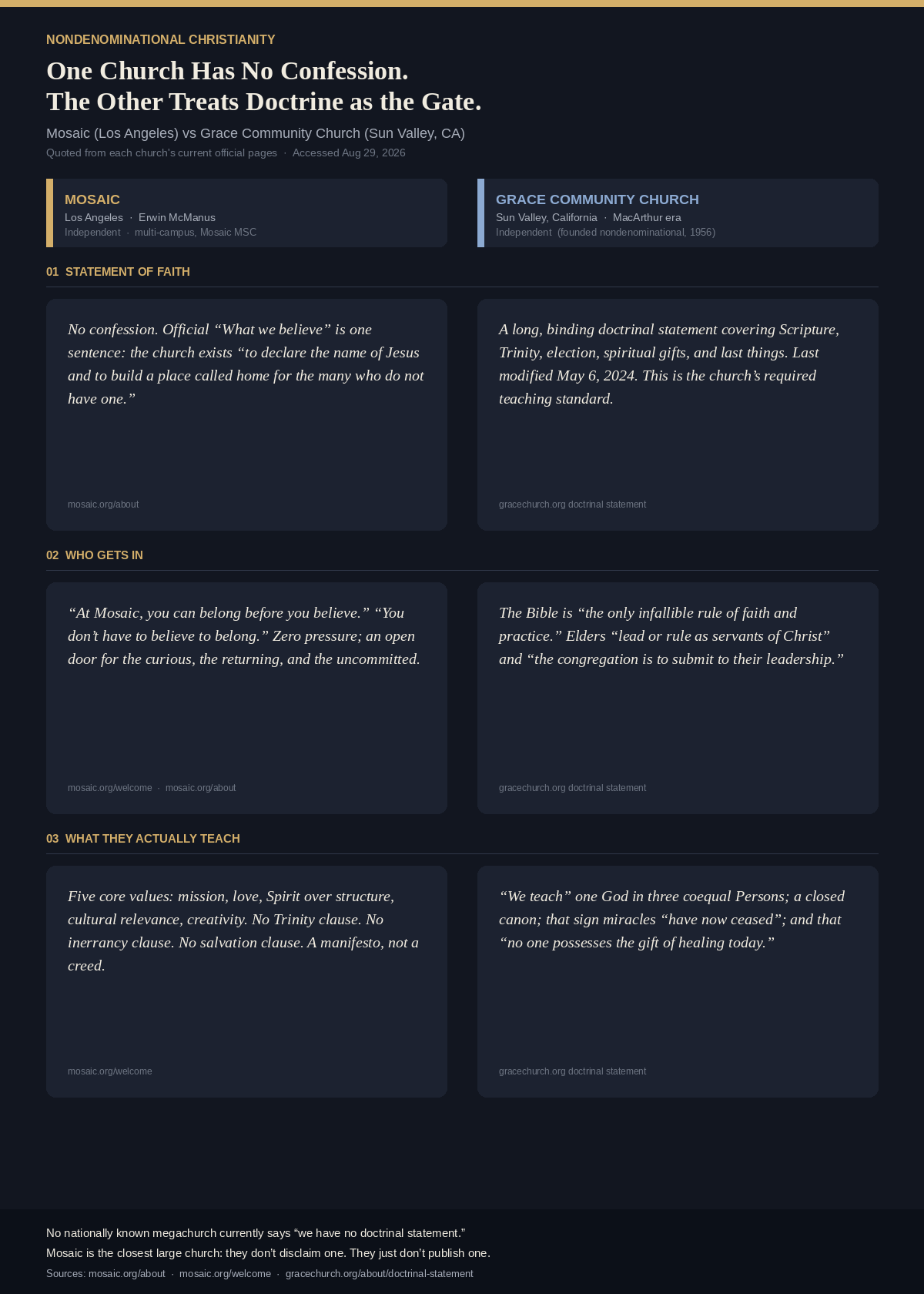
Why are we seeing a massive spike in non-Denominational Christianity? I propose it is because modern Protestants have conceded the point, either explicitly or implicitly, that doctrine no longer matters. Christianity is all about Jesus, and his teachings are whatever we “feel” or “think” they are.
There are doctrinal convictions, but there is no doctrinal authority. Everyone is his own teacher, and this means that the individual, not the Church, is the ultimate authority within the psychology of the modern Christian. St. Paul has been warning Christians about this since the early Church.
For the time will come when people will not tolerate sound doctrine but, following their own desires and insatiable curiosity, will accumulate teachers and will stop listening to the truth and will be diverted to myths.
2 Tim. 4:3-41
Many Christians believe that doctrine doesn’t matter; the chart above is enough to infer that. But if this is you, take a look at a couple of quotes from Scripture about the dangers of false teachers.
Many will follow their licentious ways, and because of them the way of truth will be reviled. 3 In their greed they will exploit you with fabrications, but from of old their condemnation has not been idle and their destruction does not sleep.
2 Pet. 3:2-32
Protestant Relativism
Talk to mainline Protestants, and you will find that for many of them the “doctrines” of the faith are clear. It’s those non-essential “doctrines” — but I contradict myself — that are ambiguous. The problem here is that no two groups of Christian denominations agree on what the doctrines of the faith are, that is, the teacchings/doctrines that require your submission to receive eternal life.
To highlight this, take a look at the various Christian teachings on Baptism. Notice the emphasis on whether or not it is for salvation.
Baptism is Not Salvific: Baptist & Presbyterian
For example, the Baptist churches and Presbyterian churches believe that baptism does nothing salvific. It is merely symbolic.
Baptists:
Christian baptism is the immersion of a believer in water in the name of the Father, the Son, and the Holy Spirit. It is an act of obedience symbolizing the believer’s faith…
BF&M 2000, Art VII3
The Westminster Confession advises baptism of infants, something not done in Baptist Churches. It also says that Baptism is not tied to salvation.
Presbyterians — at least those that hold to the Westminster Confession
Although it be a great sin to contemn or neglect this ordinance, yet grace and salvation are not so inseparably annexed unto it, as that no person can be regenerated or saved without it, or that all that are baptized are undoubtedly regenerated.
Westminster Conf., Art (XXVIII)4
These are two major Protestant traditions that reject the idea that Baptism is necessary for salvation.
That summary should be sufficient. For now, take a look at a few major Protestant Denominations that do believe baptism is essential for salvation.
Baptism is Salvific: Anglican & Lutheran
But the Anglican and Lutheran Churches believe, as St. Peter said in his epistle, that “…baptism now saves you.”
Anglicans/Episcopalians:
Baptism is not only a sign of profession, and mark of difference, whereby Christian men are discerned from others that be not christened, but it is also a sign of Regeneration or new Birth…they that receive Baptism rightly are grafted into the Church; the promises of forgiveness of sin, and of our adoption to be the sons of God by the Holy Ghost, are visibly signed and sealed…
Thirty-Nine Articles, Art 28.5
Lutherans teach something very similar.
Lutherans:
Of Baptism they teach that it is necessary to salvation, and that through Baptism is offered the grace of God, and that children are to be baptized who, being offered to God through Baptism are received into God’s grace. They condemn the Anabaptists, who reject the baptism of children, and say that children are saved without Baptism.
Augsburg Confession (1530), art. IX6
The Catholic position is that Baptism is salvific. This was the position held by virtually all Christians until the Reformation.
Catholics:
By Baptism all sins are forgiven, original sin and all personal sins, as well as all punishment for sin.
CCC (1263)
Other groups that would argue this way would be the Orthodox Churches, but we need to wrap this thing up, and no one enjoys reading lists of church doctrines. But hopefully you can see that there are major problems already.
If Baptists and Presbyterians are in error for rejecting the salvific nature of baptism, then they are definitionally heretical sects of Christianity and are risking their salvation by denying an essential doctrine of the Christian faith. But if Baptists and Presbyterians are correct, and the rest of the Christian world is in error, then the debate is irrelevant, and we should move on to some other disagreement about doctrine that does have salvific consequences. After all, every Christian should believe that their church’s teaching (i.e., doctrines) are essential for salvation. If you don’t, then you’re in the wrong church.
Hopefully from this simple example, you can see we have a problem. On the one hand, we know that the random guy in the mountains reading the Bible by himself and just “doing life with Jesus” is not an authority on what is binding on the consciences of all Christians. On the other hand, we know that not all the Non-Denominational churches are teaching the truths of Christianity. As we saw above, it’s not even clear that Mosaic church is even a Christian Church since their website offers no clear explanation of what they think Christianity teaches.
So we have to ask the question: if they can’t all be right, then who is?
Who’s Right?
The nature of truth is that it both unites and divides. If doctrine matters for salvation, then many of these Christians choosing to attend non-denominational churches are risking their salvation for two reasons:
Non-denominational Churches tend to downplay doctrinal distinctions and instead point to the number of people in the seats or emotional testimonies as the argument that God is blessing their teachings.
Truth is exclusive by its nature, and Jesus, the Teacher, said you would love him by obeying his commands.
There are plenty of Christians who claim that doctrine doesn’t matter. But I want to focus on the Christians who claim doctrine matters, but then disregard it when it does matter.
Since becoming Catholic, more and more of my friends and family have said things like,
“It doesn’t matter where we go to church as long as we have a relationship with Jesus.”
“We all have something wrong in our doctrinal statements.”
“We might go to different Churches, but all agree on the essentials.”
Of course, God does care where we go to Church because it will determine whether our relationship with Jesus is based on truths or a lie.
If something is truly a doctrine, then it has to be devoid of error, since all Christian teaching must ultimately come from God’s Word, either written or spoken.
Finally, we don’t agree on the essentials. This is why Catholics and Protestants don’t do Bible studies together, unless one is trying to convert the other.
Examining baptism above, we see that Christians don’t agree on whether or not baptism is required for salvation. Baptism is a salvific sacrament, or it’s not, and the majority of Christians for all of time were completely and totally wrong. Regardless, someone is getting it wrong, and whoever is, taking a lot of people to hell with them.
Today, people are having an extremely concentrated experience with the fact that they can get a bird's-eye view of so many Christian groups in the world. This perspective allows observers to see that Christianity is fractured and that they don’t agree with each other on major doctrinal issues. Unless, of course, there is a Church that has held the line doctrinally. In which case, Christianity is not fractured. Sheep have merely wandered away from the fold, listening to whoever will tickle their ears.
Because people are experiencing this fact, it is leading people to conclude that they need to find the Church that Christ founded. Alternatively, people are overwhelmed and are falling prey to isolating themselves from any doctrinal commitments, which will only lead them to sin and insanity.
In the end, we are seeing that there are two types of Christians: those who recognize the role of the Church as the defender and teacher of sound doctrine and therefore the only one who can answer the question authoritatively and affirmatively, “What do Christians have to believe?” Those who think the Church has minimal authority over individuals and their beliefs are the ones most likely to find themselves at non-denominational, multi-campus, mega churches.
Those in the first group, the ones that care about doctrine and truth, are more likely to become Catholic. Those in the second group are more likely to church-hop based on the charisma of the preachers and the emotional highs they get from the music. Those left over are more likely to become agnostic, atheist, or Satanists and witches.
Authority & The Trinity
Most Protestants don’t even realize that their belief in the doctrine of the Trinity, that is the formulation of the doctrine as three persons and one divine essence, came from the Catholic Church. These Christians wrongly believe, most likely from the propaganda that comes from a sola scriptura worldview, that their pastors were trained on how to, only using the scriptures, derive the orthodox doctrines around the Trinity and the Incarnation. But this is not the case.
For example, many Protestant Christians will claim that they can deduce the doctrine of the Trinity from scripture alone. But when they say this, they take for granted that St. Athanasius, the early Church Councils, combined with the development of doctrinal terminology, are the only reason their vocabulary contains the word “Trinity.”
This is because the Trinity was defined by the Church and promulgated by her teaching offices (e.g., Popes, Bishops, Priests, and Deacons). This summary of the Trinity — three persons and one essence — is not found in Scripture. That is because the Church invented new words and meanings to define and defend the Trinity authoritatively:
In order to articulate the dogma of the Trinity, the Church had to develop her own terminology with the help of certain notions of philosophical origin: "substance", "person" or "hypostasis", "relation" and so on. In doing this, she did not submit the faith to human wisdom, but gave a new and unprecedented meaning to these terms, which from then on would be used to signify an ineffable mystery, "infinitely beyond all that we can humanly understand".
CCC (253) 7
The Church had to develop “her own terminology” for the Trinity. This means that if you’re a Protestant today speaking about the unity between the Son and the Father, or attempting to understand it, you’re indebted to the Catholic Church because it was her saints, doctors, and martyrs who defended this doctrine so you could study and preach it today.
The Trinity and its definition are not something that you would have just “picked” up from a “clear” and sincere reading of the scriptures. You would have to be taught the Trinitarian doctrine by someone who already had it taught to them.
Secondly, most people fail to realize that the Trinity is the most profound mystery of the Christian faith. This is depicted in the final line of the paragraph, “infinite behind all that we can humanly understand.” To think that this is just something that was “figured” out by smart people or that it was just a really hard puzzle to solve is a very prideful posture to take.
But because Protestants take the facts and historical development of doctrine for granted, they believe that armed only with their Bible and intellectual determination, they too could derive the Trinity and its definition entirely on their own. But they would have most likely ended up a heretic.
That is the thing people fail to realize about heretics is that they are often extremely knowledgeable on doctrine and scripture, as well as very charismatic in their speaking. That is precisely the case with Arius, who espoused that Christ was not divine.
Arius’s heresy gained massive momentum in the early Church, even after his position was condemned by the councils. But the reason that heresy was stymied was due to the Church’s authoritative teaching office, not because a couple of deacons and pastors got together with Arius in their local church and had an exegetical Bible study into the late hours of the night.
St. Jerome gives some insight into the spread of this heresy in his work, Dialogue Against the Luciferians, and how the heresy’s supporters ignored the Church’s authority and effectively promulgated the heresy throughout the region:
After these proceedings the Council [Nicea] was dissolved. All returned in gladness to their own provinces. For the Emperor and all good men had one and the same aim, that the East and West should be knit together by the bond of fellowship. But wickedness does not long lie hidden, and the sore that is healed superficially before the bad humour has been worked off breaks out again. Valens and Ursacius and… eminent Christian bishops of course, began to wave their palms, and to say they had not denied that [Jesus] was a creature, but that He was like other creatures. At that moment…the Nicene Faith stood condemned by acclamation. The whole world groaned, and was astonished to find itself Arian.
Jerome, Dialogue Against the Luciferians 198
Some will claim the Bible as authoritative, and it is, but it is not a summary of doctrinal teachings. For example, it says nothing about IVF, Cloning, Body augmentation, or gestation of babies outside the womb. All of these are ethical issues that have profound moral impacts on society, but many Protestants will say, “Well, if the Bible is silent on it, then it’s permissible.” Hence, the reason why abortion ultimately took off among Protestants, since the Bible did not clearly and explicitly define life at the moment of conception.
When two people both agree that Scripture is authoritative, but they don’t agree on a doctrine, there has to be a third office that can judge the contradicting parties and their interpretation. This is not a uniquely Catholic thing either. It’s just how institutions function and survive division. If every soldier had his strategy implemented during World War II, the Allies would have failed to conquer the Axis powers. Someone has to give the orders, someone has to argue for his strategy, but a commanding authority has to ultimately be the one who makes the decision. Otherwise, the army or institution will fracture and eventually dissolve.
Without that kind of authority structure in the Church, then doctrine is no longer about revelation from God, but instead is reduced to reason alone, not faith alone, to determine what is and is binding on all the faithful.
For example, as mentioned above, to deal with difficulties around the Father, Son, and Holy Spirit, the Church had to develop new terms and meanings for existing terms in order to adequately explain what the doctrine of the Trinity meant. But they still had to develop this over several years.
Following this apostolic tradition, the Church confessed at the first ecumenical council at Nicaea (325) that the Son is &uot;consubstantial" with the Father, that is, one only God with him. The second ecumenical council, held at Constantinople in 381, kept this expression in its formulation of the Nicene Creed and confessed "the only-begotten Son of God, eternally begotten of the Father, light from light, true God from true God, begotten not made, consubstantial with the Father".
CCC (242) 9
According to the Catechism of the Catholic Church (CCC), the teaching on the Trinity formed between two councils: the Council of Nicea in 325 A.D. and the Council of Constantinople in 381 A.D.
Today, the Trinity is a binding doctrine on all Christians everywhere; whether they reject or accept it is a different issue. This is the binding doctrine on all Christians everywhere.
Conclusion
Truth is exclusive, and doctrines are merely truth claims about Christianity. The internet and AI have exposed in extreme clarity the full extent of doctrinal confusion there is between the various Christian sects that cannot agree on what is or is not a part of the Christian doctrines. That is why many have just assumed that doctrine is an irrelevant part of Christianity. But without doctrine, our salvation is at risk. Doctrine, according to St. Paul and St. Peter, is clearly meant to protect us from falling into sin or damnation.
We are faced with two propositions: either we can know what the Christian faith teaches, and therefore only one Church has the fullest expression of those teachings, or no church has doctrine 100% correct and Christianity, at its core, is a spiritual agnosticism and the Gates of Hell actually prevailed where the Church has failed.
Furthermore, if the latter is true, that no one has doctrine 100% right, then the wisest thing a Christian can do is fall back on private interpretation as their own pope, council, and magisterium. It may seem like a humble position to say that you won’t pick a denomination as the best expression of Christianity, but all you have done is elevated your own acumen above the cumulative acumen of the history of Christianity, something that C.S. Lewis would have called “chronological snobbery.” The only person happy that you’re taking this position is the Devil.
If the former is true, that Christ really did establish a Church as the guardian of the truths of Christianity, then your entire reason for being on earth is to find that Church or die trying. One thing is for sure: it’s not going to be some hip new non-denominational Church that sprang up a couple of years ago.
— DR.
2 Tim. 4:3-4 (NABRE)
2 Pet. 2:2-3 (NABRE)
Baptist Faith and Message 2000, arts. VII, Southern Baptist Convention, https://bfm.sbc.net/BFM2000/
Westminster Confession of Faith (1646), ch. 28.5, in The Westminster Confession of Faith, The Westminster Standard, https://thewestminsterstandard.org/the-westminster-confession/#Chapter%20XXVIII.
Thirty-Nine Articles (1571), arts. 25, 27, Church of England, https://www.churchofengland.org/prayer-and-worship/worship-texts-and-resources/book-common-prayer/articles-religion
Augsburg Confession (1530), art. IX, in The Book of Concord, https://bookofconcord.org/augsburg-confession/article-ix/
St. Jerome, Dialogus contra Luciferianos 19 (PL 23:181–182), written c. 379, on the Council of Ariminum (Rimini) in 359, https://www.newadvent.org/fathers/3005.htm
Thanks for reading everyone!
What do you think is the reason non-Denominational Christianity is on the rise?
The one thing that Ryan did not cover is why people choose the authority that governs their life. As a social scientist, he could often be dealing with peoples underling motivations. Why would a person follow the authority of Buddhist or Muslim or Baptist or Catholic or whatever religious group. The fun would be the follow up survey that delved into the why of the choice.