


Given that it is still Christmas, my family and I decided to watch the classic Christmas film, It’s a Wonderful Life. Earlier this weekend, we also saw the new animated film put out by Angel Studios, David. The latter was a decently made film with beautiful animation, some fun characters, but very unlikely to be a “classic” in the sense of Christian movies like Prince of Egypt or movies like It’s a Wonderful Life. David is having success, not because it was an incredible movie, but because our standards for quality entertainment are in the dumpster. We have been conditioned to applaud a “good ole college try,” which has its place, rather than to appreciate a quality production.
Today, we get movies that may have great action through the magic of green screens and computers, but now the actors appear lifeless and “soap opera” like. We may get a movie that has a great score in terms of the music, but the story may be rushed and lacking the character development that leads to scenes like when Jimmy Stewart is praying in a bar for dear life. In a movie like David, we see a film that can be carried by the divine inspiration of the Bible, but is bogged down by our modern evangelical feminization of male heroes. The movie was fun, but it will not be memorable. After watching It’s a Wonderful Life and seeing George Bailey battle his Goliath, you realize that Jimmy Stewart’s character is not just larger than Goliath, but larger than life. Why is this?
It’s a Catholic Thing
Whether the directors of It’s a Wonderful Life were Catholic, Jewish, Muslim, or some myriad of Protestantism is something on which no comment will be made. Frankly, it doesn’t matter. The movie is Catholic, whether the creators intended it to be or not.
This is not to say that the movie is preaching the Catholic faith either, but rather that the story is more meaningful when viewed the way a Catholic views the world, that is, to view it sacramentally. That is, the idea that the visible, what we can see with our eyes, reveals an invisible truth that is needed by our souls. Secondly, the Catholic views the world through typologies, patterns of things that overlap with other things, not only literally but also analogically.
This can be person to person, as in Adam being the man through which sin entered the world, and Jesus, the man through whom sin was eradicated, or it can be object to object, as in the Kingdom of Israel in the Old Covenant and its foreshadowing of the New Kingdom of God in the new Covenant, the Church. It can even connect objects to persons. This is seen in the manna from Heaven, which Jesus reveals is a foreshadowing of the flesh he will give to us for salvation. The Tree of Life is also a foreshadowing of Mary; the fruit of her womb gives eternal life. Mary is the Tree, and Jesus is the Fruit. Just as when God says, “Now, what if [man] also reaches out his hand to take fruit from the tree of life, and eats of it and lives forever?” (Gen. 3:22), so God-the-Man, Jesus Christ, says of his own flesh,
“‘Whoever eats my flesh and drinks my blood has eternal life, and I will raise him on the last day.”
— Jn. 6:54
This way of looking at the world is not common among modern authors that I have read (if you know of some, drop them in the comments), unless they were practicing a Christianity that was sacramental. Is it any wonder that C. S. Lewis and J. R. R. Tolkien are some of the greatest authors to have lived, and their theological view was not to view scripture or the world through a rigid literalism or fundamentalism, but rather to create worlds that had concrete heroes, villains, and weapons that pointed to spiritual truths. In other words, they wrote their stories sacramentally and typologically. With Lewis, we have the Lion of Judah represented by Aslan the Lion, and for Tolkien, we have Hobbits who are flawed and bumbling heroes (i.e., very much like Christians in God’s plans) deemed essential to the salvation of Middle-earth, and whose sustenance is Lembas bread, a food that is made by the angel-like elves and which possesses the properties of the Eucharist.
Thus, we should not be surprised that It’s a Wonderful Life is a classic, that is, it follows a similar “sacramental” or “typological” approach to its story.
The Catholic Lens
Some people will credit It’s a Wonderful Life’s success to its loss of copyright in the 70s. This allowed it to be aired on public television for many years, free of charge. Certainly, exposure is half the battle for a film’s success, but exposure does not guarantee its success. There are plenty of films that play every year around Christmas, Die Hard comes to mind, but while Die Hard may be a movie that happens around Christmas, it is not a Christmas movie per se. Besides, once Generation Z floods the movie queues with anime slop, the joke will have lost its steam, and some other movie will take the “It’s a Christmas movie. Prove me wrong” debate stage. But I don’t think It’s a Wonderful Life will fade from the Christmas classics collection anytime soon.
This is because It’s a Wonderful Life is a Christian story, in that it imitates the method of storytelling in the Bible. It is a uniquely Catholic story in this regard. It never names the theological principles, dogmas, or points explicitly. It leaves those truths to the reader to deduce. This is why the word “Trinity” is never found in the Bible, yet we all believe it as Christians because it’s clearly pointed to in the text. Similarly, theological things are “dimly” discussed, and even sometimes crudely dumbed down so as not to distract the viewer, but they are still there nevertheless.
The film’s opening scene is of friends and family praying for a man named George. One man says, “I owe everything to George Bailey. Help him, dear Father.” Another man, Italian and clearly Catholic, prays, “Joseph, Jesus, and Mary, help my friend, Mr. Bailey.” Finally, it closes in on a house, and we hear a woman’s voice, “I love him, dear Lord. Watch over him tonight,” followed by two girls praying for their daddy to come home.
The scene fades out, and a starry night fades in. A cratered moon moves crudely across the screen as the camera moves in on two “galaxies” talking to each other. One identifies himself as Joseph, the other never discloses his identity. According to the film credits, it is a “senior angel.” They send for the clockmaker. His name is Clarence. This world is not strictly speaking the world of the Bible any more than a Marvel Comic is the reality in which we live, but that is what gives the story its mythological quality and ensures the viewer learns the lesson presented, rather than overthinking specialized theological terms or verbatim quotes from the Bible.
For example, we know that the angel Joseph must be St. Joseph, despite the fact that he is called an angel. This is not accurate theology entirely because, in actuality, St. Joseph is greater than the angels, as are all the saints. St. Paul reminds us, “Do you not know that we will judge angels?” (1 Cor. 6:3). But this deviation from proper theology is an example of why Catholic storytellers are better than evangelical ones.
A Catholic with the conscience of an evangelical would feel the need to be theologically precise, which would bog the story down and make it exclusively accessible to the evangelicals with a biblical knowledge level high enough to make the connections. For the rest of the world, it would cause them to ask the question, “What’s the difference between an angel and a saint?”, distracting them from the main storyline.
That said, it’s clear that the angel Joseph is actually St. Joseph because of the opening prayers, the only prayer in which individuals are actually named comes from the Catholic man named Martini, who prays, “Joseph, Jesus, and Mary, help my friend Mr. Bailey.”
From these opening prayers, and from the rest of the development in the movie, it becomes clear that It’s a Wonderful Life is intended to be universal in an analogous way to the Church’s universality. All Christians, and many non-Christians, are going to be moved by this movie, and once a year, whether you're Catholic or Protestant, a movie with subtle Catholic theology makes its way into the hearts and minds of every Christian in America.
The Devil and the Saint
Moving ahead, we see that George is a “Christ figure” only so far as the disciples were “Christ figures,” that is, imitations of Christ. Many people who enjoy film will ask the question, “Who is the Christ figure?” They typically identify a “Christological” character based on how willingly and heroically the character sacrifices himself. George Bailey willfully sacrifices, but he does so in his own strength. This begins to naw and eat away at him till he nearly gives up, contemplating suicide. An example of a Christological figure from another story would be Aslan, the Lion who is the creator of Narnia and other worlds, and who dies for the sinner, Edmund, as the perfect sacrifice. This is not George Bailey; he is entirely too sinful to be a Christological figure. No, George is a sinner on his way to sainthood, but he’s got a long way to go. George is far more like Peter than he is like Jesus.
Jesus said to Peter, “Simon, Simon, behold Satan has demanded to sift all of you like wheat, but I have prayed that your own faith may not fail; and once you have turned back, you must strengthen your brothers” (Lk. 22:31-32). What we witness in It’s a Wonderful Life is George Bailey being sifted by the Devil, Mr. Potter. When George has completed his trial, he will be sent back to “strengthen” his brothers. But first, George tries to fight the Devil on the Devil’s own terms.
Mr. Potter is clearly the Devil throughout the film. In this respect, the film takes on a Job-like theme. Potter is restrained to his wheelchair and confined to his bank, symbolizing the temple of the “root of all evil,” the love of money. Potter is not physically strong, but he is spiritually and demonically formidable. He does not come at George with weapons like the Nazis and Japanese did against George’s brother, Harry, but it is alluded that Potter is just as evil as the heels in “Germany and Japan” by Uncle Billy, the man who loses George’s 8,000 dollars.
Potter’s weapons of choice are the same weapons that ensnare souls to Hell: comfort, greed, and power. He is a tempter and an accuser. He is diabolical in his ruthless attacks on George’s soul, highlighting how George is unable to obtain his dreams and fortune. If he can’t break George’s spirit with spiritual attacks, then he will do it through the manipulation of law enforcement to persecute and throw George in jail. The moment George has “technically” broken the law, it is Potter who is ready to call the cops, have him arrested, thrown in jail, and put out of business, all in the name of “justice.”
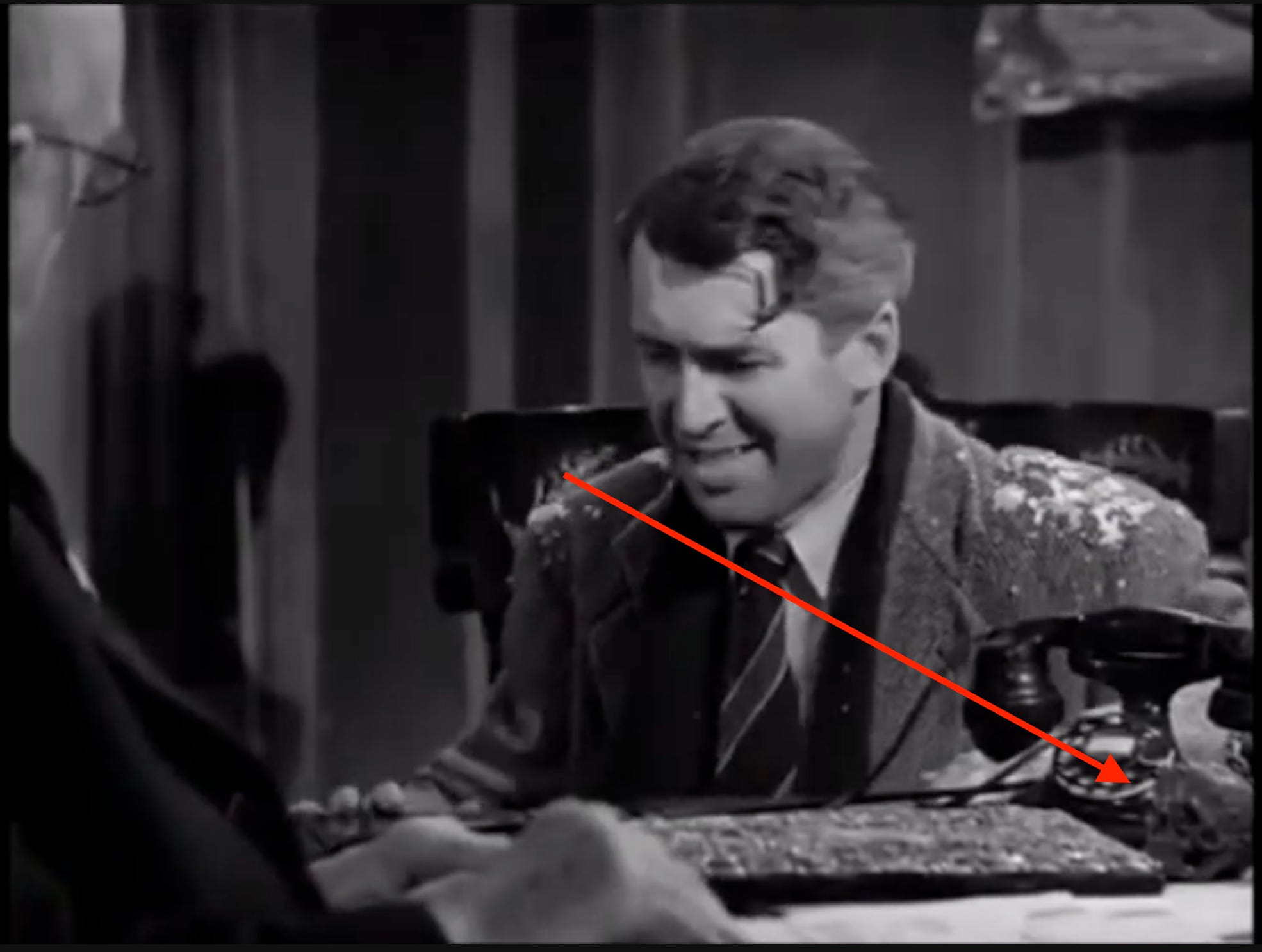
But what symbols do we see onset that would indicate that Potter is a kind of demon sent to torment George? For one, we see prominently displayed on his desk a skull. The image below was the best I could find, but if you watch the movie, you will see several scenes where the skull is in the corner of the frame, looking directly at the camera.
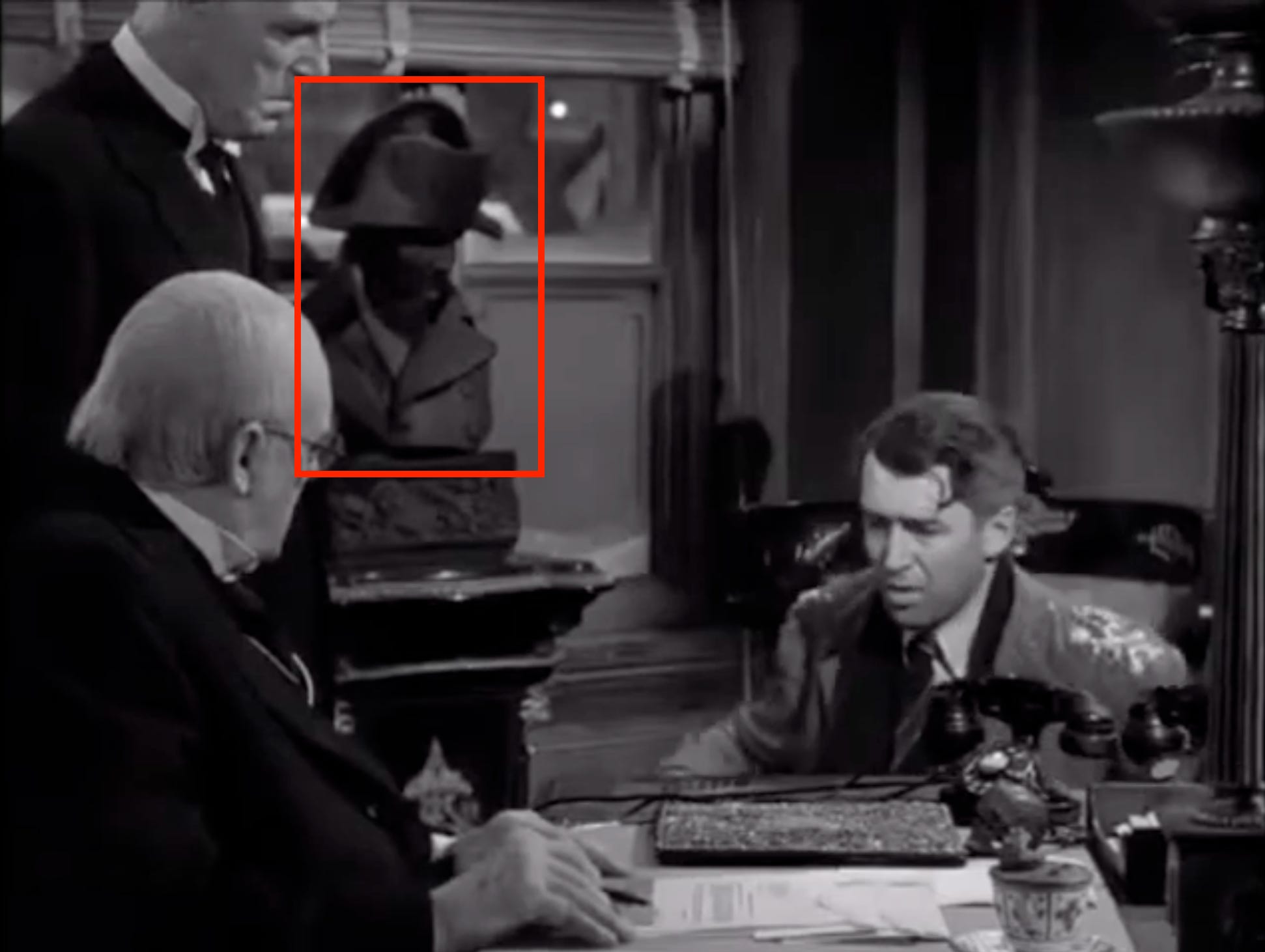
Secondly, we see one of the main enemies of the Catholic Church, Napoleon Bonaparte, a major persecutor of the Catholic Church. Napoleon famously invaded the Papal States and imprisoned Pope Pius VII. Bonaparte’s statue, being visibly present and blackened, clearly symbolizes the totalitarian and demonic spirit with which Potter attempts to rule both George Bailey’s life and the community of Bedford Falls.
Finally, we know that Potter is representative of the Devil because he is the only character who prides himself, well, on himself. His office is adorned with pictures of himself. He has begun to call so many evil things good that he is actually willing to praise the evil within himself as good by elevating himself within his office. Another characteristic of divine restraint is that men must go to him; he is not permitted to go to them, not unless he commands one of his “minions” to move him there. Potter is powerful, and more powerful than George and his good works. This is precisely why George needs the grace of God to defeat him. The only problem is that George is not a praying man…yet.
From Sinner to Saint
In George’s most desperate moment, he goes to what man naturally thinks will be his salvation, Potter, the Devil. George has been sacrificing his entire life. Potter has made sure to point that out, as well as highlight that this lifestyle has only brought George poverty and failure. Potter is also the accuser, telling George that he is a failure in the eyes of the world, and Potter is right.
But in the eyes of Heaven, George is exactly what the world needs. George doesn’t realize it yet, but his suffering is precisely what God uses for the salvation of others. But I’m getting ahead of myself.
George realizes that he has lost his 8,000 dollars and is on his way to jail if he doesn’t find a remedy. Judgment day is coming — a very similar theme to Advent, by the way, but that would make our analysis far longer than it should be— and George naturally goes to the vice that is holding him back from becoming a saint; George believes that money will solve his problems.
George sits unnaturally low in a chair in Potter’s office, placing him a little lower than Potter. Man was made a little lower than the angels, says the scriptures, but when man seeks his salvation from money, he becomes a little lower than the demons. This is symbolized by the fact that throughout the film, George is always taller than Potter, except when George is begging Potter for help. This is also echoed by our Lord, Jesus Christ, when he says that “the root of all evil is the love of money. You cannot serve both money and God.” George is turning to money, and in doing so, it almost kills him.
George Bailey is a typical sinner. He thinks that if he does good things, that will be enough to make his life fulfilling. He doesn’t know why he’s sacrificing so much for everyone, but he knows it’s the right thing to do; he lacks revelation, something that suffering tends to bring about, whether we like it or not.
This is evident by the fact that George turns Potter down after Potter offered George a job. George is about to take the offer, but after shaking “the Devil’s hand,” George has a grace that illuminates his conscience. Don’t make a deal with the Devil, George.
George responds and turns down the offer. But it’s not enough to say no to the Devil; you still have to say, “Yes” to God, otherwise you will end up right back in Potter’s chair, lower and more helpless than before, which is precisely what happens to George.
Until George prays his famous “Dear Father in Heaven” prayer, he has believed that he can make it through life on good ole American hard work and pragmatic living. He’s helpful to his neighbors, loves his wife and kids, probably even goes to Church occasionally, but he still has not turned to God. He believes that if he just does enough good things, then, through his sheer will, tenacity, and pragmatism, he will beat ole Potter and save Bedford Falls. But self-sacrifice without grace, as the Devil knows, will only lead a man to a breaking point where he has to choose between God and the Devil.
Self-sacrifice is the way to sainthood, but without grace, it just destroys the sinner. George is missing something, mainly the grace that only God can give, a grace that will cure George of his trust in money by replacing it with a love of God and love of neighbor. We know George’s spiritual state is one of pragmatic humanism because of his prayer,
“Dear Father in Heaven, I'm not a praying man, but if you're up there and you can hear me, show me the way. I'm at the end of my rope. Show me the way, God.”
George’s cry for help rattles Hell, and he is immediately struck in the face by Mr. Welch, but it rings in Heaven as well, and Clarence, the second-class angel, is sent to George’s aid. Clarence later reminds George that he, Clarence, is the actual answer to George’s prayer, not Mr. Welch’s fist. But before this conversation, George nearly attempts suicide, a mortal sin that would have condemned George’s soul to the fires of Hell. This is one of the biggest indicators that Potter is the Devil. It is also one of the more Catholic moments of the film.
“Suicide, that’s against the law,” says one of the characters while Clarence and George dry off from the cold swim in the river. “It’s against the law where I come from, too,” says Clarence. This is a reference to the teaching in the Church that a man who commits suicide commits a mortal sin, presuming he was fully aware of the graveness of the evil, damning him to Hell. But Clarence comes in at just the right moment and demonstrates how God uses grace and man’s free will in coordination to save sinners.
Clarence famously jumps off the bridge first, and then begins the sequence of scenes that reveal to George what life would be like if George had never been born. The only thing worth pointing out here is that Potter is never seen during this part of the film. Potter’s name and fingerprints are everywhere in Pottersville, but he is nowhere to be found. It is as if George’s absence has released him from his confines, and now the demonic spirit of Potter has possessed both the town and the souls of the citizens. One key scene is when Violet, a tiny blond girl and flirt, is seen raging violently against four police officers who are trying to wrestle her into a police vehicle. One could read it as just a strong blonde or her having a demonic strength. After all, the only thing we can make out of her shrieks is, “I know Potter.”
George concludes this “never been born” scene with three prayers to God, very similar to Peter’s prayer on the beach to Jesus. When Peter is asked three times if he loves Jesus, Peter says, “Yes, of course I do,” three times in response.
George is given a similar question, but it is implied, not stated, “George, do you want to live again?” to which George replies three times, “I want to live again. I want to live again. I want to live again.” As if remembering who he should send these three prayers to, George concludes with, “Please God, let me live again.”
Embrace the Suffering
In the final scenes of the movie, George begins to see all his suffering through the eyes of Heaven. It is analogous to how a new Christian sees the suffering of Christ: what was once a bloody, gruesome, and violent murder now takes on a beauty and redemption that can only be seen by faith. Similarly, George has had his eyes opened to what was missing in his self-sacrifice, mainly the grace needed to offer it up to God.
He begins to express joy for all the suffering in his life. He’s excited about his mouth bleeding, he’s excited about Zuzu’s dead flower pedals, he’s excited about his broken-down car, the broken banister, and even the prospect of going to jail. But he’s also thankful for the gifts of his family and his wife, Mary.
As he comes down the stairs, his wife comes in wearing a veil, a hallmark sign of the Blessed Virgin in the Catholic Church. Mary, George’s wife, is not a 1-to-1 match of Mary in the teachings of the Church, but that doesn’t mean she does not point to Mary’s role in the lives of believers in any way at all.
There is a very important line that comes from Uncle Billy that will highlight why Mary is a type of Mary, our Heavenly Mother. First, is that her prayer at the beginning is merely described as a woman praying. All we hear is, “I love him, dear Lord. Watch over him tonight,” and it is this prayer, along with her children’s prayers, that storms the gates of Heaven to save their George.
After entering the home, she removes her veil. Mary brings George into the living room and clears a table, runs to the door, and yells, “Come in, Uncle Billy!” Uncle Billy, the man who lost the 8,000 dollars, comes into the home with a basket full of money. Mary helps him pour it on the table. While Uncle Billy dumps the money in front of George, Uncle Billy says, “Isn’t it wonderful. So many friends. Mary did it. Mary did it, George.”
We discover that while George was discovering what the world would be like without him, Mary was going throughout the town seeking those willing to help the man who had sacrificed so much for their town. She interceded for George in a way that he could not. More money piles on the table.
Finally, a man informs George that Sam Wainwright has wired him 25,000 dollars. Cheers erupt from the crowd in the house, and Mary, in a similar way to the Mary at the Wedding in Cana, says, “Mr. Martini, how about some wine?” At this point, George’s daughter starts to play, Hark the Herald Angels Sing, which highlights the fact that George, having been baptized in the cold waters of the river, having participated in death, is now alive. The last line we hear before Harry comes in is, “God and sinners reconciled.” George has been reconciled to God, but only by the prayers of the faithful and the grace that can turn a man from hating his life to realizing it’s a gift.
It’s a Wonderful Life is a beautiful movie, not because it is rigid in its theological storytelling, but because it is truthful in its theological imagery. George cannot become a saint if he keeps fighting Potter on his own, and we can’t do it either; we need Christ in the sacraments, which, if you pay attention, make frequent symbolic appearances in the film. George needs to keep loving his neighbor as himself, but the key deficiency with George is that he lacks the grace to endure the trials that self-sacrifice brings. In the end, life is worth living, but we will only be able to survive it if we have the bread and wine that the crowd feasted upon in the living room of George’s home. It is only then that our sacrifice, even if it kills us, will be used by God for our good and for the salvation of souls.
— DR