


Whether you are Protestant or Catholic, there is a lot of confusion around mortal sins. Some of this has to do with our differences around whether one can lose their salvation or not, anti-Catholic writers who slander the Church, and Protestants who prefer to judge the Church based on misunderstandings, rather than an accurate representation of the doctrines.
Today, we’re answering the following questions:
What are mortal sins?
Who can commit them?
Why are they misunderstood?
As always, my goal is not to condemn anyone, but merely to communicate the faith with clarity and love. If you feel judged or condemned, know that is not my intent. You may not believe that mortal sins are real, but try to see it from the Catholic’s perspective.
It is always more prudent, in a situation where extreme consequences are uncertain, to live as if they are. If you live as if mortal sins exist, and after your death you discover that mortal sins were just a “manmade tradition,” then you’ve lost nothing. But if you live your life in rejection of the teachings on mortal sin, only to find out after your death that the teaching was true, then you’ve potentially lost everything.
Clearly, depending on what you believe about the severity of sin, there are theological consequences. Some of that will be evident in the subsequent paragraphs. However, the main goal of this, and pretty much every other article, is simply to clearly state the teaching, not necessarily give the most rock-solid apologetic for it.
Mortal sin and its consequences…
As with all theological concepts, there are terms and definitions that need to be defined. For a sin to be mortal, there are three requirements (CCC, 1857).
The sin must be a grave matter (e.g., adultery, blasphemy, fornication, murder, etc.).
The person must have full knowledge that the action is grave.
The decision to sin was completely free.
When all three of these qualities are present in a sinful act, the sin is no longer venial or grave, but mortal. Venial are minor sins, while grave sins are sins that could be mortal. The primary difference between mortal and grave sin is a question of culpability, not a question of severity. In other words, all mortal sins are grave sins, but not all grave sins are mortal sins.
This is because it is possible for you to commit grave sins against your will or without a full understanding of what you’re doing.
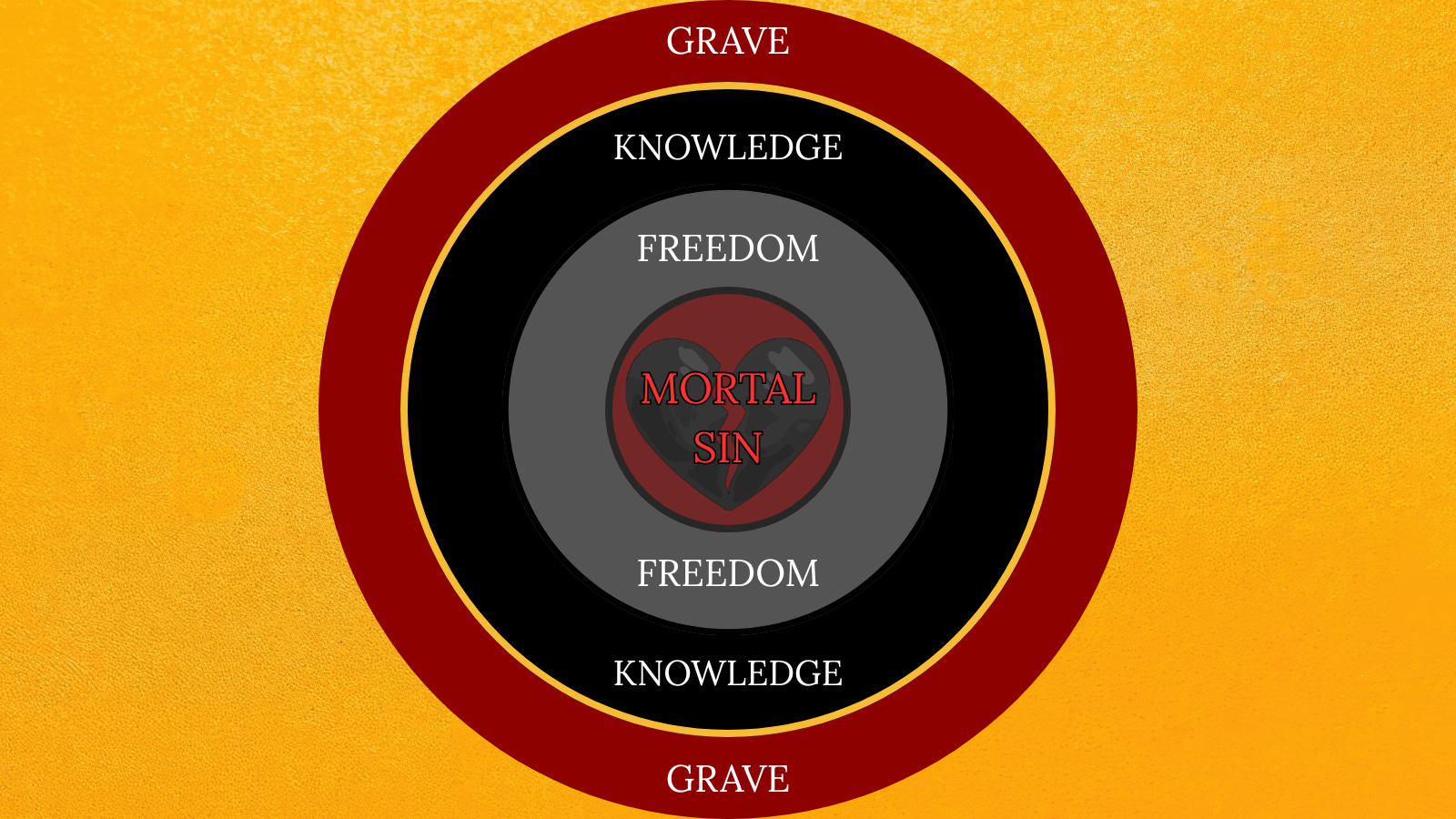
Here is a small graphic to help visualize it. The outer ring is the objective part, Grave matter. The inner rings, Knowledge and Freedom, are the subjective parts of the act. Only God and the individual know with certainty the degree of knowledge and freedom they had when they committed to sin. When we say “committed a mortal sin,” we just mean that they committed a grave sin knowingly and willingly.
The consequences of mortal sin are damnation. This is clearly taught in scripture and by the Church. The Lord Jesus and his disciples all indicate that Christians can commit egregious sins and that these actions exclude someone from the Kingdom of God. The Catechism of the Catholic Church (CCC) says it this way,
To die in mortal sin without repenting and accepting God’s merciful love means remaining separated from him for ever by our own free choice. This state of definitive self-exclusion from communion with God and the blessed is called “hell.” — (CCC, 1033).
Some people might be saying to themselves, “But where does the Bible talk about mortal sins?”
It’s clear from St. Paul’s writings in multiple letters that particular sins can cut off a baptized Christian from the grace of God. Consider the fact that St. Paul’s letter to the Galatians is written, not to non-Christians, but to Christians. In it, he lists out sins that can lead to a person not inheriting the Kingdom of God,
Now the works of the flesh are obvious: immorality, impurity, licentiousness, 20 idolatry, sorcery, hatreds, rivalry, jealousy, outbursts of fury, acts of selfishness, dissensions, factions, 21 occasions of envy, drinking bouts, orgies, and the like. I warn you, as I warned you before, that those who do such things will not inherit the kingdom of God.
— Gal. 5:19-21
This is not the only list, either. St. Paul has lists in other letters as well. But the passage that is most often cited by Catholic apologists and Protestants who deny the evangelical teaching of “once saved, always saved” is actually the first epistle of John.
If you see any brother or sister commit a sin that does not lead to death, you should pray, and God will give them life. I refer to those whose sin does not lead to death. There is a sin that leads to death. I am not saying that you should pray about that. All wrongdoing is sin, and there is sin that does not lead to death.
1 Jn. 5:15-17
Additionally, Jesus infamously talked about the “unforgivable sin,” which is blasphemy of the Holy Spirit, which is another example of the brutal nature of sin. It also debunks the idea that Christians can figure out “everything” they need for salvation simply by reading the Bible.
Finally, the book of Hebrews gives many examples of sin excluding former Christians from their heavenly inheritance. The author writes,
For it is impossible in the case of those who have once been enlightened and tasted the heavenly gift and shared in the holy Spirit 5 and tasted the good word of God and the powers of the age to come,6 and then have fallen away, to bring them to repentance again, since they are recrucifying the Son of God for themselves and holding him up to contempt. 7 Ground that has absorbed the rain falling upon it repeatedly and brings forth crops useful to those for whom it is cultivated receives a blessing from God. 8 But if it produces thorns and thistles, it is rejected; it will soon be cursed and finally burned.
— Heb. 6:4-8.
These are only a few of the many passages that indicate that our actions play a role in salvation. This is not to say that works save us, because it is only grace that saves us (Eph. 2:8-9). Rather, it is to show that egregiously evil actions are not merely incompatible with the Christian life; they are destructive for it. Some Christians will say that those who commit these sins were “never saved to begin with,” but no such verse supports this claim.
Who can commit mortal sins?
The short answer is everyone. There is a common misunderstanding that both Catholics and Protestants share. One of them is that only Catholics can commit mortal sins. This false perception can cause a Catholic to resent his Catholic upbringing, and it can also lead a Protestant to believe his salvation is more secure outside the Church than within her.
This is understandable because there are some sins that only a Catholic could commit. For example, if a Catholic skipped Holy Mass on a Sunday to go to the bar and watch his favorite football team, he would most likely be committing a mortal sin.
But what about Protestants or non-Catholics? How could they commit a mortal sin?
It’s important to remember that the Church is universal. The Church is calling everyone to live according to her teaching because it is the truth, and by living in the truth, we are saved. It is the ordinary means of salvation for all men and women. This means that her teaching is promulgated throughout the entire world. Those who reject her teaching do so at their own risk.
The grace found in the Church and the sacraments are the ordinary means to obtain this grace. But that doesn’t mean that God does not have extraordinary ways of conferring saving grace to those who do not have access to the sacraments. That Catechism says it this way, “God has bound salvation to the sacrament of Baptism, but he himself is not bound by his sacraments” (CCC, 1257).
However, on the topic of mortal sins, we might ask how the following groups find themselves guilty of mortal sin:
Catholics
Protestants
Non-Christians
We have already considered the Catholic. Theoretically, he has more knowledge about God’s plan, the wickedness of sin, and the remedy for mortal sins than either of the other two groups. Contrary to popular misconceptions, this gives the Catholic more grace to endure, not less. A soul that has more access to the truth and is more receptive to it is significantly more likely to persevere to the end. Not to mention, Catholics have access to God’s plan for healing us from mortal sin, which is the sacrament of confession.
On the topic of Protestants and Non-Christians, both of these could still commit grave sins against their neighbor. For example, both could still commit murder, for example, say through IVF, contraception, or abortion, and this would constitute a mortal sin. IVF is a good example because it’s highly unlikely that anyone would commit this grave sin. In this scenario, all parties involved are made aware of the details of the procedure, which necessarily involves the loss of embryonic life, aka children.
Even if you didn’t agree with the Church on her teaching, the fact remains that if her teaching is true, then it’s completely possible that a Christian or non-Christian outside her protection could violate her commandments and incur judgment.
Some might claim that this is not fair because they are unaware of everything the Church teaches. This objection does not stand up to scrutiny for several reasons:
Firstly, if you are truly ignorant. Meaning, you are completely ignorant of the morality of an action, then the sin is grave and not mortal. It should be clearly stated that no one accidentally ends up in hell. They choose to go there by refusing to obey Christ (Jn. 3:36; Mk. 16:16).
Secondly, even if people disagree that the Church’s teaching is for the whole of humanity, that doesn’t really matter because the Church believes her teaching is for the whole of humanity. In Pope Paul VI’s famous encyclical, Humanae Vitae, he addressed it to “ALL MEN OF GOOD WILL.”
TO HIS VENERABLE BROTHERS
THE PATRIARCHS, ARCHBISHOPS, BISHOPS
AND OTHER LOCAL ORDINARIES
IN PEACE AND COMMUNION WITH THE APOSTOLIC SEE,
TO THE CLERGY AND FAITHFUL OF THE WHOLE CATHOLIC WORLD, AND TO ALL MEN OF GOOD WILL,
ON THE REGULATION OF BIRTH
In one of the Vatican II documents titled Gaudium et Spes, the document explicitly states that the Church’s teaching is for the “whole of humanity.”
Hence this Second Vatican Council, having probed more profoundly into the mystery of the Church, now addresses itself without hesitation, not only to the sons of the Church and to all who invoke the name of Christ, but to the whole of humanity.
— Gaudium et Spes, 2.
So, even if someone does not believe that the Church's teaching applies to them. The fact remains that the Church believes her teachings apply to the “whole of humanity.”
Thirdly, most non-Catholics do know the teachings of the Church. Consider this video from a woman talking about the Catholic Church during the advent of contraception. In the video, she acknowledges that it was only the Catholics who were the “naysayers” on contraception, and then proceeds to list all the evils that the Catholic Church predicted would come about if the world embraced contraception.
Furthermore, when you talk to non-Catholics, especially Protestants, about the moral teachings of the Catholic Church, most Protestants know what the Catholic Church teaches on a particular subject more than many Catholics. For example, I’ve spoken with several Protestants who are intimately aware of the Church’s teaching on contraception and IVF, and they openly reject those teachings precisely because of the specifics of the teachings. In fact, most Protestants are pro IVF, even though it murders ~4x the number of babies killed in abortions per year.
The only denomination that condemns IVF and surrogacy outright is the Catholic Church. The rest of them, and this includes the most conservative denominations, encourage it, at best, “with caution.”
To be clear, we are not saying that to disagree with a Church teaching automatically damns someone to hell. Disagreeing with a Church teaching could lead someone to commit mortal sins, but you cannot commit a mortal sin simply by disagreeing. One would have to commit the action before any question of salvation would arise.
Finally, it is true that there are those who might be unaware of some of the Church’s teaching on an issue, per se. But this does not mean that they could arrive at a conclusion shared by the Catholic Church through natural reason. For example, it’s possible that a non-Catholic couple is considering IVF and they are completely ignorant of the Church’s teaching on the matter. But they are not completely ignorant of the moral laws that God has written on their hearts.
When that couple enters the doctor’s office, they are made aware of the procedure (knowledge). This procedure will necessarily require them to make a decision (freedom). This decision will involve deciding the fate of the leftover embryos. They can abort the embryos or freeze them indefinitely (grave matter). To abort a child is to murder that child. These couples will have to then sign a document acknowledging their understanding and the decided fate of the human lives. From our perspective, this would appear to be a mortal sin, but the final judgement is left to God, not to us.
The promptings of feelings and passions can also diminish the voluntary and free character of the offense, as can external pressures or pathological disorders. Sin committed through malice, by deliberate choice of evil, is the gravest…Although we can judge that an act is in itself a grave offense, we must entrust judgment of persons to the justice and mercy of God.
— CCC, 1860-61.
For the scriptural understanding of this concept, we can look at St. Paul’s letter to the Romans. He reminds us that the law of God is written on the heart of every man, and that it is by this standard that those outside of God’s law will be judged,
Ever since the creation of the world, his invisible attributes of eternal power and divinity have been able to be understood and perceived in what he has made. As a result, they have no excuse; 21 for although they knew God they did not accord him glory as God or give him thanks. Instead, they became vain in their reasoning, and their senseless minds were darkened…Although they know the just decree of God that all who practice such things deserve death, they not only do them but give approval to those who practice them…
For it is not those who hear the law who are just in the sight of God; rather, those who observe the law will be justified. 14 For when the Gentiles who do not have the law by nature observe the prescriptions of the law, they are a law for themselves even though they do not have the law. 15 They show that the demands of the law are written in their hearts, while their conscience also bears witness and their conflicting thoughts accuse or even defend them 16 on the day when, according to my gospel, God will judge people’s hidden works through Christ Jesus.
Rom. 1:20-21,32; 2:13-16
Why is this teaching misunderstood?
The reason why Mortal Sins are misunderstood is that there is an objective part, which is grave matters of sin. This part is knowable with certainty. But the part that is murky is the freedom and knowledge the individual had during the act. To be clear, it is murky to the observer; it is not murky to the sinner. This is because the willful act of a sinner and their understanding of the sin are known only to them and God.
In reality, the only thing that we can identify objectively when another person sins is whether the sin was a grave matter or not. We cannot know the heart of a man. But it’s important to note that this does not give us license to say, “Well, they probably didn’t commit a mortal sin. After all, there is a chance they were ignorant!” If someone is committing a grave sin, it is all the more important that you warn them precisely because the stakes are so high.
For example, Abortion is a grave sin. When we look at our diagram at the beginning, we see that both the sinner and the observer have the ability to know with certainty that the sin in question is an exceptional evil or grave matter.
The reason that mortal sin is misunderstood is that one group emphasizes the objective nature of mortal sin to the exclusion of the subjective. They make every sin a mortal sin. The other group emphasizes the subjective elements, what they can’t know, over the objective ones. Whenever a discussion about a celebrity or non-Catholics committing mortal sins, it’s always presumed that these individuals are doing so from a place of invincible ignorance. But this is dangerous, since they could be presuming that someone is innocent when they are actually guilty.
We should not presume judgment of any soul, since to do so would ultimately lead us to apathy in our prayers for these individuals. Furthermore, if we presume that everyone outside the Church is ignorant and therefore off the hook, so to speak, then we are failing in our evangelism. I always tell my wife, when we see the statistics of Christians, especially Catholics, who believe that mortal sins like gay marriage, abortion, contraception, etc., are actually good, people need to remember that someone is dropping the ball in that relationship. Either the priests and bishops are teaching false doctrine, in which case they are likely falling into mortal sins, or it’s the people rejecting the teaching of the Church in favor of the teachings of the world. Either way, someone is risking their salvation, either the teachers, the sheep, or both.
In the end, Catholics must recognize that they are accountable for living out the teachings of the Church. That includes evangelizing those around us and warning people about the dangers of sin, whether they are Catholic or not. We must do so with love and wisdom, of course, but we should avoid presuming that the majority of the world will be saved by their ignorance. Only the truth saves, and we come to this saving grace by the “knowledge of salvation by the forgiveness of their sins.”
The Church and Holy Scripture are clear that salvation is only found in the truth. Invincible ignorance, which is a technical term for those who have zero knowledge about a moral or spiritual obligation, is rare for most people in the world. If we are Christians, one of our primary tasks is to warn the world about the dangers of sin, while simultaneously preaching about the means of grace found within the Church and the sacraments.
Conclusion
When it comes to mortal sin, we can always look at the technical definition. But rarely do we enter into an analytic frame of mind prior to committing a damnable offense. That’s not typically how sin works. It’s more like tooth decay.
A person feeds on food that they should not consume. It leads to the weakening of the enamel. Then one day, they take a bite like they always have, and “crack!” Their tooth is cracked, and now they need to see the dentist.
This is similar to mortal sin. It comes on slowly, usually through a bad habit, but then its consequences are manifested suddenly and aggressively. Fortunately, there is the mercy of God. Even in sin, there is the opportunity to encounter great good through the sacrament of confession.
One of the greatest things about being Catholic, is is the confessional. For many converts, it is the most unique aspect of converting because it is the one sacrament that most denominations rejected. But there is nothing like it. Many times I have walked out of the confessional and felt a bittersweet sensation. Sweetness of heaven that I could utter the sins I’ve committed, and have them forgiven. But bitterness knowing that there are so many of my friends and family who have yet to taste this grace.
When we sin, we can relate to Eve, our first mother, in the garden, “Did God really say?” says the serpent. We succumb, sin enters, shame erupts, and we are tempted to hide ourselves from God and man.
But when we enter the confessional, and we kneel in front of that screen, we are kneeling beside heaven’s gate. We are like the sick man waiting by the city gates for the savior to pass us by and speak his words of power over our sickly bodies. As we kneel, we realize we did not just “make this up in our heads,” we were drawn by the Holy Spirit to the Great Physician. As we confess, we hear those words of absolution, and we echo a revelation that Peter had in the Gospels, “Master, to whom shall we go? You have the words of eternal life.”
— DR
Daniel J. Roberts writes on faith, reason, and culture from a Thomistic perspective. A Catholic layman passionate about applying St. Thomas Aquinas to modern questions, he explores theology, ethics, and the pursuit of truth in everyday life. You can find him on X at @ThomisticDan
Thanks for reading! Let me know what you thought of the article. How would you explain mortal sin? Protestants, did you feel like it was clear?