


A group of Christians has received mixed reactions about unveiling a gold-leafed President Trump statue. This is problematic for several reasons.
Why are some Protestants promoting golden statues of a guy who, only a few weeks ago, had posted an image of himself as Jesus? Are statues always bad? If statues are a way to honor a person’s life and virtues, then why don’t more non-Catholics set up statues in honor of the saints?
Statues Rise, and Statues Fall
In case you missed it, a group of pastors and political donors, approximately 6,000 in total, decided that they were going to erect a gold-leafed 22-foot bronze statue of President Trump. Draped across his shoulders are white and blue sashes. The optics, not to be conveyed with the intent, are not great. The statue evokes images of Nebuchadnezzar and his golden statue, while also potentially offending Catholics who notice that he seems to have Marian sashes draped over him. To be clear, none of this seems like it was what they intended, but it still garnered a significant amount of condemnation from Christians.
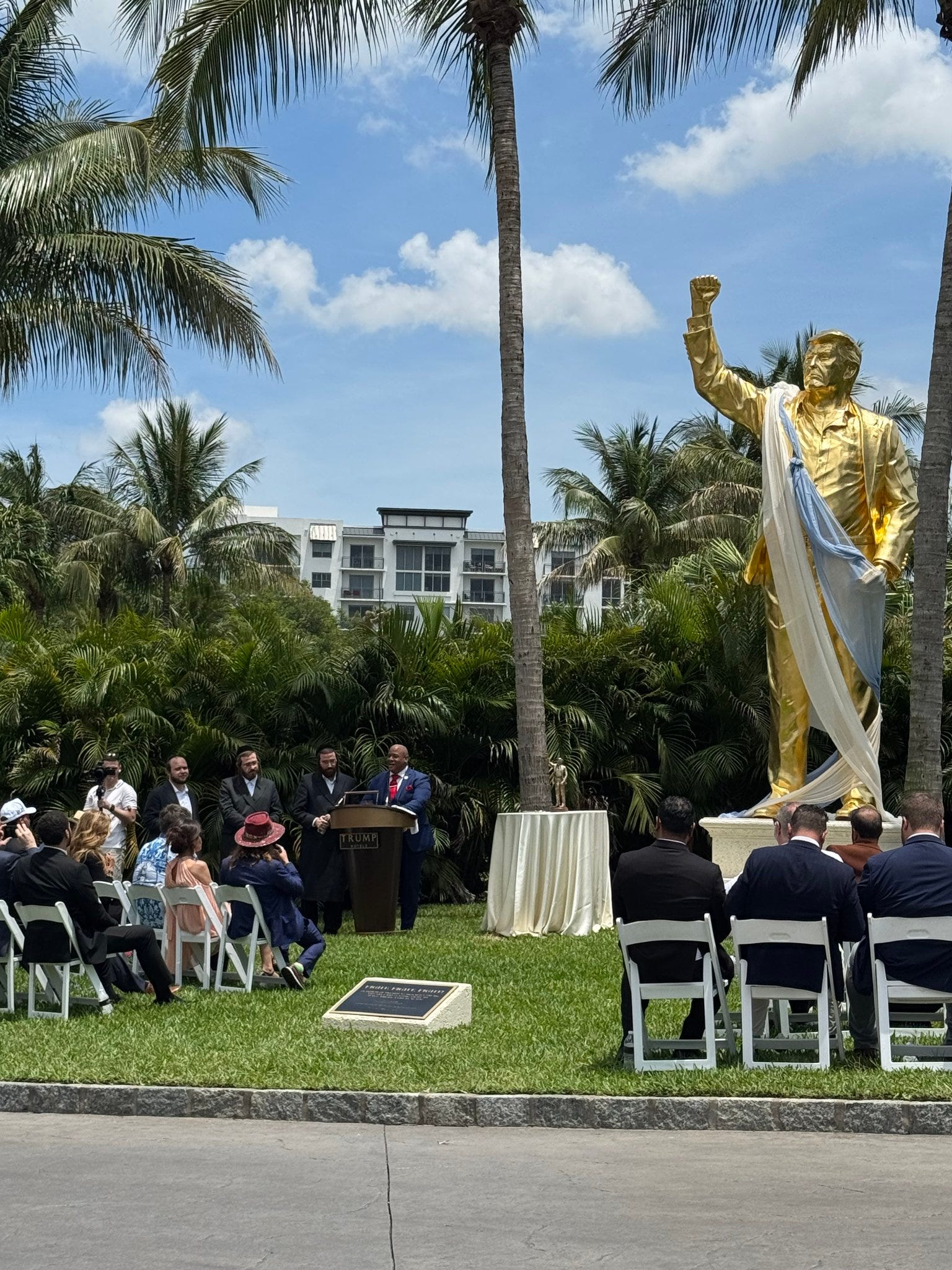
There is nothing wrong per se about statues. We have them all over the country. Abraham Lincoln, George Washington, Mount Rushmore, and the monuments to fallen soldiers are all examples of the ways that Americans venerate their political leaders. This is a good and healthy thing to do. Statues are a sign of who is in charge, and that is one of the reasons why political and religious revolutionaries, after taking power, frequently tear down the previous regime’s icons and statues.
In her book Mao’s America, Chinese Communist survivor Xi Van Fleet talks about how revolutionaries tend to destroy the statues of the previous culture in order to give the impression that the old has passed away and the new ideology has taken the reins of history. Her book was released in 2023 after the Black Lives Matter riots.
One of [the] most public and visible cancel culture actions in America is the toppling of monuments and statues…In Western countries, monuments and statues are usually found in public spaces and the heart of a city or town. The action of tearing down these structures created fear-driven spectacles that have the effect of demonstrating the progressives’ power that they are in control of our culture and our history.
Mao’s America: A Survivor’s Warning (175)
Tearing down statues is a way to “bend the arc of history” towards your own vision, has always been the sign of conquering your enemy. It’s not just communists who recognize this idea, but it’s throughout the Old Testament scriptures. In Deuteronomy, God commands Israel to do this as a sign that Israel’s God is the only God.
When the Lord, your God, brings you into the land which you are about to enter to possess, and removes many nations before you…This is how you must deal with them: Tear down their altars, smash their sacred pillars, chop down their asherahs, and destroy their idols by fire.
— Deut. 7:1, 5-6.
This concept is not limited to the Biblical Israelites.
Communists, Muslims, Jews, and Protestants have all taken the opportunity to destroy the statues and images of Catholics. For the Communists, they saw this as purging God from their nation. Solzhenitsyn speaks about this in his novels and his account of the Gulag Archipelago.
For the Muslims, they saw this as a demonstration that Allah had conquered the Infidel. Growing up in the era of social media, I can remember having a conversation with a friend after hearing that some Middle Eastern Christians, most likely Catholic or Coptic, had decided to stay and defend a Christian historical site and its relics. The Muslim extremists were going through the villages and destroying all the Churches. English Historian, Tom Holland, recounts walking through destroyed Catholic churches where the altars and statues had been destroyed with power tools.
Most recently, images circulated of Israeli soldiers desecrating crucifixes with sledge hammers, an offense that soldier was imprisoned and which Netanyahu personally addressed on his social media channels. Another video was circulating of an Israeli soldier mocking the Blessed Virgin outside of a damaged church.
Protestants, throughout the world, often accompanied by significant shifts in political power, deployed their government and church members to destroy Catholic art and sculptures. This movement was known as “Iconoclasm.” Key figures of this movement were Calvin and Zwingli, as well as King Henry VIII, who not only purged the country of Catholic art but also brutally persecuted Catholic priests and parishioners. Most recently, Christian Nationalist, pastor, and influencer, Doug Wilson, made comments that under his brand of Christian Nationalism, he would ban Eucharistic and Marian processions.
[Doug Wilson] begins the segment by explaining how Muslims will be treated, saying that whilst they can live and worship as a community, the call to prayer would not be permitted. He explains that Catholic church bells would be permitted, “but a parade in honour of the Virgin Mary, carrying an image of the Virgin Mary down [Main Street], no”.
— From the Catholic Herald, Thomas Edwards. 1
Doug is a nice guy, but he’s also anti-Catholic in a lot of ways. Some have praised him for his consistency on his views, but this also highlights that our ecumenical veneer is fairly thin. As we tear down statues and set up new ones, it’s clear that we are in a cultural civil war. If it were to escalate, it would be a serious test of the ecumenical relations we have built up thus far.
Where the tearing down of statues occurs, new regimes rise up and elevate their own image in the form of monuments, statues, and art. Art is the incarnation of the abstract identity known as a nation. We imitate God in this act. We take dirt, clay, mud, steel, or words, and we inform that material with the ideas we have; we breathe our life into them.
God does this more profoundly in the Garden when he takes dirt, forms man, and then breathes into his nostrils. Analagously, we are doing something similar, but similar in the way a child might build a house out of Lego bricks in order to imitate his father, who builds houses with hammers, nails, power tools, wood, and concrete.
These works of art are the incarnation of abstract ideas of nation, religion, and family, the three building blocks of any community. Writings, pictures, structures, statues, etc., are all indications of the identity of a particular group.
If you saw the Ark of the Covenant, you would immediately think of Israel. If you see Marian statues, you immediately think of the Catholic Church. At one point, if you saw a pulpit in the center of a stage, you would expect the Word of God to rest on the wood just as the Word made flesh rested on the wood of the Cross. When you see a golden statue of Trump, you immediately think of…well, only time will tell.
It’s Not a Golden Calf…
That’s what was said by Pastor Mark Burns on social media when he posted the images of the Trump statue. According to the Christian Post, Burns is a televangelist and “ally of President Donald Trump.”
I’ve never thought that Trump looked like a cow, but I guess this is a lesson for all of us. Don’t go with gold leafing, or else people will think you do look like a cow!
It’s obvious that it is not a golden calf, but what exactly were pastors and donors trying to communicate when they decided to bring this idea to life?
According to Burns, as quoted in the CP article,
“This statue is not about worship. It is about honor,” Burns wrote. “It is a celebration of life and a powerful symbol of resilience, freedom, patriotism, courage, and the will to keep fighting for America.”
— Christian Post, Anugrah Kumar2
There is nothing wrong with those sentiments, but apparently, many were still offended.
Other prominent Protestants took to the X platform to offer a harsh defense of the statue. Eric Metaxes accused those scandalized by the statue of having “TDS”— Trump Derangement Syndrome.
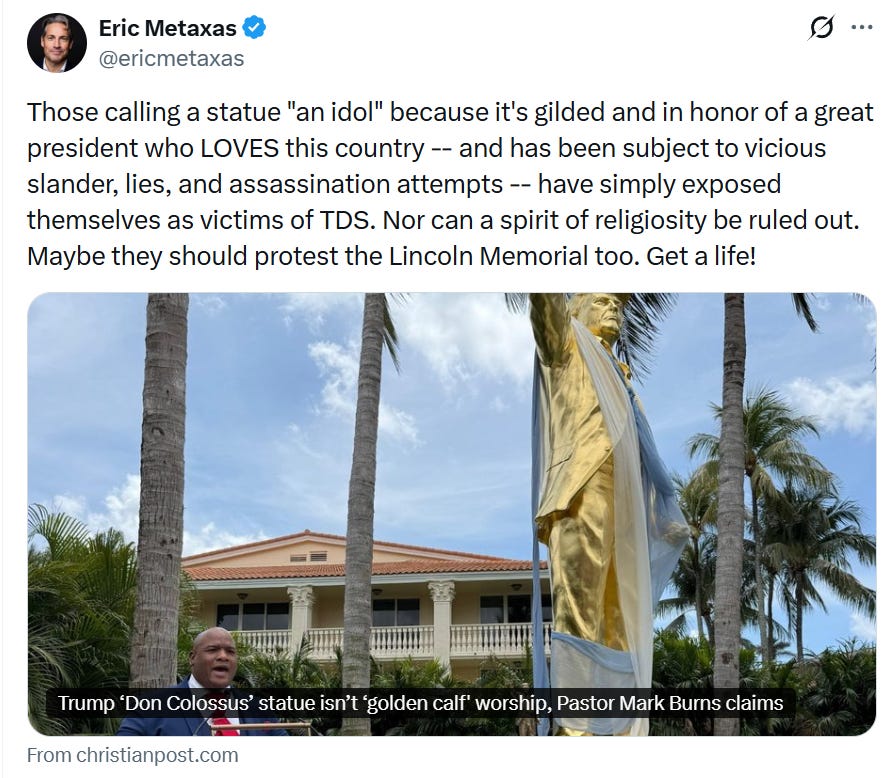
Metaxas’s charge here is a bit too harsh. Maybe people are just turned off by the Babylonian artistic choices…people can dislike something and still support the President.
Protestants are known for being scandalized by statues or images of holy things, and this statue of Trump clearly evokes idolatrous images from the Old Testament. For example, Protestants who object to statues often direct their attacks at Catholic and Orthodox churches for their statues honoring the saints. This is often from an anti-Catholic bias or a misunderstanding of the Second Commandment, which says,
You shall not make for yourself an idol or a likeness of anything in the heavens above or on the earth below or in the waters beneath the earth; you shall not bow down before them or serve them.
Deut. 20:4-5
So, it’s not “Trump Derangement Syndrome” for Christians to be scandalized by a golden statue of a political figure that resembles the statue in the story where three young Jewish men are thrown into the fiery furnace.
Pastor Mark Burns continued to describe the meaning and intent of the statue.
It also stands as a reminder of the hand of God and His protection over President Trump’s life. Time and time again, when his life was threatened, God’s mercy prevailed.
This is religious language. So, it is understandable that Protestants who are scandalized by any kind of religious art would be scandalized by a 22-foot golden statue of a guy who, a few weeks ago, posted a picture of himself as a “Red Cross Doctor.”
Given the divine fingerprints on our nature, it makes sense that citizens would desire to erect statues of men who have, in their eyes, done great things for God, their families, and their country. Whether or not Trump has successfully done these things to warrant a golden image of himself is debatable.
But from the spiritual side, this statue and the responses from Metaxas and Pastor Burns reveal a deeper spiritual problem.
Does Doctrine Matter?
Erecting a statue of Trump is not a sin per se. Statues are legitimate expressions of commemorating events, people, places, or things. But how we do that matters. The way that these Protestants have done this does create a theological problem for them.
On the one hand, Protestants will claim that they agree on the essentials, but do they? One group of Protestants says that this is idolatry, another group says that it’s honoring a man trying to save America. The disagreement provokes the question, “Is idolatry a salvation issue?”
Most Christians would say “yes,” but where they would disagree is on what constitutes idolatry. Which is a serious question if your soul depends on it. Furthermore, are any Protestants certain about what is and is not an idolatrous action? If they can’t agree, then how do they know who is committing idolatry and who isn’t?
Protestantism doesn’t exist, but Protestants do. Individual Protestants can claim they have unity in the essentials, but their disagreement over the Trump statue demonstrates this is merely a claim and not a reality.
Protestantism continues to say that freedom to disagree on such issues is a feature, not a bug. But then faith leads to uncertainty, and doctrine becomes an exercise in rationalism, not in faith. This leads one to believe that there is no reason to “work out their salvation” in fear and trembling, because after all, doctrine is a secondary issue.
Some will charge Catholics with the same divisiveness as Protestants because individual Catholics don’t agree on things, or they get things wrong. But the difference is that where Catholics may disagree in thought or word, they are united in deed because of their universal submission to what the Church teaches authoritatively are the essentials, not what any one of their peers says are the essentials.
Do Protestants Honor Mary?
The fact that these Protestants are willing to sacrifice time and money to erect a statue of Trump, while Mary, the Mother of God, is seen as just another woman in the Bible, is one of the clear evidences that Protestantism has systemic problems within it.
God loved Mary; He honored her more than any other creature, and yet, Protestants are quicker to set up a statue in honor of Trump than they are to honor Mary at all.
The fact that the Trump statue was draped in white and blue sashes might have been a nod to Catholics.
Most Protestants don’t know this, but white and blue tend to be the colors that Mary is wearing when she appears to Christians, and when she is depicted in art. At Fatima, Mary was clothed entirely in white. When Mary appeared at Lourdes, France, she was depicted as wearing all white and having a blue sash around her waist. Throughout Christian art, she is typically seen wearing blue to signify that she is the new Ark of the Covenant.
When the camp is to set out, Aaron and his sons shall go in and take down the veil of the screen, and cover the ark of the testimony with it; 6 then they shall put on it a covering of goatskin, and spread over that a cloth all of blue, and shall put in its poles.
Num. 4:5-6
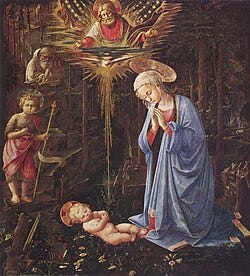
Mary is seen as the New Ark of the Covenant, and she has been since the earliest years of the Church. The same man who defended Christ’s incarnation and the Trinity also affirmed Mary as the New Covenant’s Ark of the Covenant.
“O noble Virgin, truly you are greater than any other greatness. For who is your equal in greatness, O dwelling place of God the Word? To whom among all creatures shall I compare you, O Virgin? You are greater than them all O [Ark of the] Covenant, clothed with purity instead of gold! You are the ark in which is found the golden vessel containing the true manna, that is, the flesh in which divinity resides.”
— (St. Athanasius of Alexandria (c. 296–373 AD), Homily of the Papyrus of Turin).
Arguing against this typology reveals more about a man’s character than his intelligence. If you don’t honor what God honors, then your spiritual priorities are perverted.
Mary is recorded in scripture as saying, “All generations will call me blessed.” Do Protestants bless Mary? Certainly, some revere her and honor her. But many Protestants, if they were even given a Rosary, would throw it in the trash because they would believe that they had been given a demonic amulet. But we should pity them, not judge them, especially for those of us who were once Protestant and are now Catholic. We must always remember that it wasn’t by our own merit that we came into the Church, but by God’s grace and the prayers of the Saints.
Catholics will frequently say that when you honor Mary, you will begin to realize just how incredible Jesus is and what he has done for us. I didn’t understand this when I came into the Church. Then I did a Marian consecration, which is basically a devotional around the life of Mary and Jesus.
The one I did was by St. Louis de Montfort. After going through the consecration, I realized that Mary was infinitely a better human being than I was, not by her own merit, but by God’s grace.
The only other thing that contained the presence of God was the Ark of the Covenant. She is the one creature that Christ united with in a way that no other human being will experience. Her “Yes” is the beginning of all the great things Christianity has to offer, including Salvation in Christ. Whether you are Protestant or Catholic, you are indebted to the Mother of God.
So, if we truly desire to be like Christ, then we must honor His Mother as He honored Her. We must listen to Her, the way Christ listened to Her. And we must submit to Her, the way that Christ submitted to Her. For in doing so, we are not only imitators of Christ, but we truly become His brother and sister, and she becomes our Mother.
— DR
Daniel Roberts is a Catholic convert from Protestantism with a Master’s in Philosophy in Religion from an evangelical seminary. My writing explores the intersection of faith, culture, and technology.
Trump statue ‘Don Colossus’ isn’t ‘golden calf’ worship, Pastor Mark Burns claims. Accessed, 5-16-2026.
Thanks for reading! What do you think? Did the people who put this statue up go too far? Are people overreacting to the statue?
It’s not the second commandment that prohibits “graven images.” It’s part of the first.